Siding is more than an exterior design element—it is a critical protective system that shields your home from moisture, temperature changes, pests, and long-term structural deterioration. When siding begins to fail, the damage is often hidden behind the walls, silently affecting framing, insulation, and even foundations. Homeowners frequently underestimate how serious problems with vinyl siding and other siding materials can become if left unaddressed.
Understanding the most common siding issues—and how they impact different materials—can help you take action before small defects turn into expensive structural repairs.
Why Siding Plays a Critical Role in Structural Protection
Siding functions as the first line of defense against environmental exposure. Its primary purpose is to prevent water infiltration while allowing the home to breathe. When siding is compromised, moisture finds its way behind walls, leading to wood rot, mold growth, corrosion, and insulation failure.
Over time, these conditions weaken load-bearing components, reduce energy efficiency, and create safety risks. Regardless of whether your home has vinyl, aluminum, cement, or steel siding, material-specific failures can expose the structure beneath.
Problems with Vinyl Siding That Homeowners Often Ignore
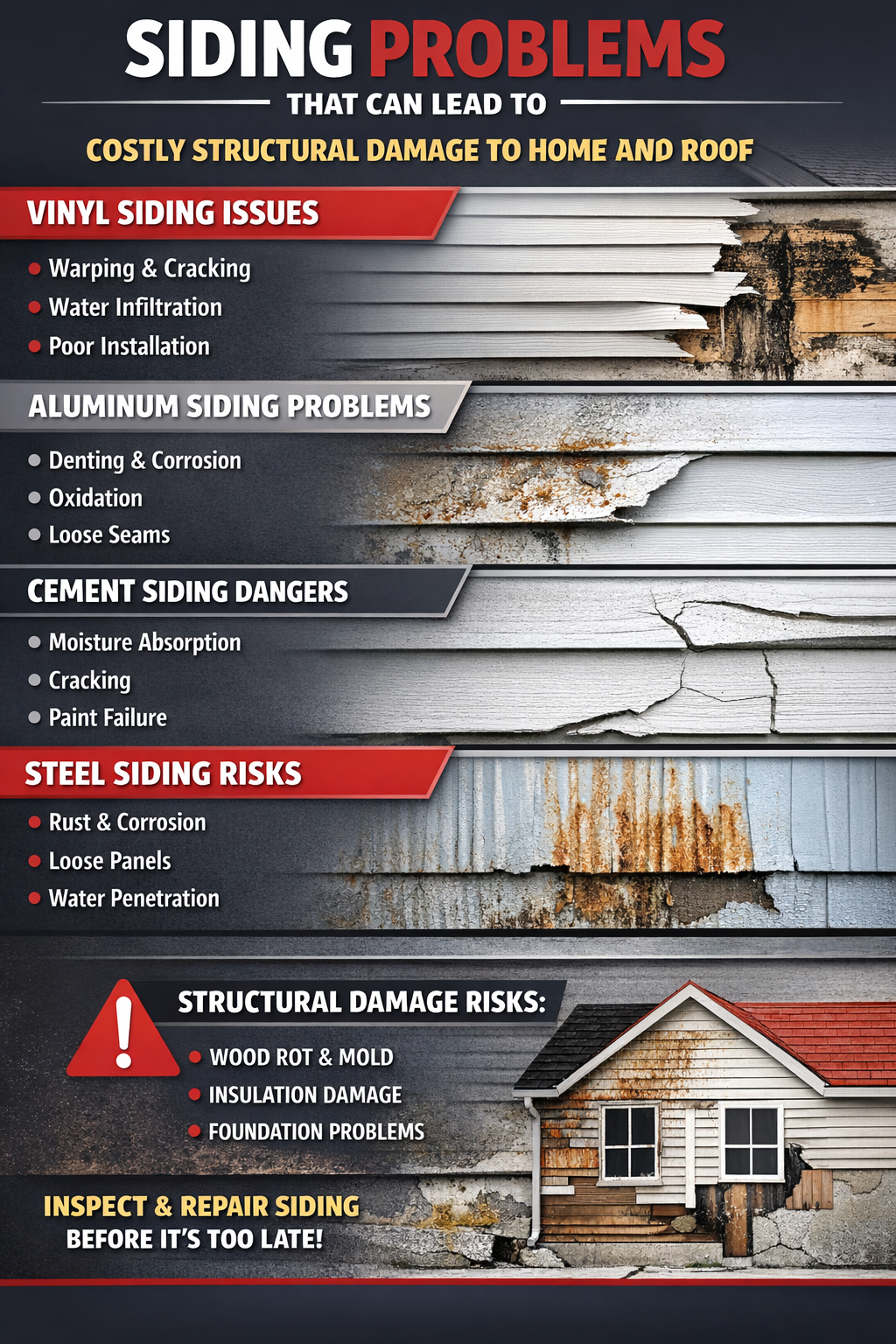
Problems with vinyl siding are among the most common issues seen in residential exteriors, largely because vinyl is widely used and often misunderstood as “maintenance-free.” While vinyl is durable, it is not indestructible.
One of the most serious issues is warping caused by heat exposure. Vinyl siding can deform when installed too tightly or exposed to reflected heat from windows or grills. Once warped, panels no longer sit flush against the wall, creating gaps where wind-driven rain can penetrate.
Cracking is another concern, particularly in colder climates where vinyl becomes brittle. Small cracks may seem cosmetic, but they allow moisture behind the siding, leading to rot in sheathing and wall studs. Over time, this can compromise the structural integrity of the exterior walls.
Improper installation is also a major contributor to vinyl siding failure. Without correct flashing, drainage planes, and expansion allowances, water becomes trapped behind the panels. Trapped moisture is one of the leading causes of hidden structural decay.
Aluminum Siding Problems and Their Long-Term Impact
Although aluminum siding is less common today, many homes still rely on it for exterior protection. Aluminum siding problems typically stem from its susceptibility to denting and corrosion.
Aluminum dents easily from hail, debris, or impact. While dents may appear to be a cosmetic issue, they can alter water flow across the siding surface. Improper water runoff increases the likelihood of moisture infiltration behind the panels.
Oxidation is another major issue. Over time, aluminum reacts with oxygen, forming a chalky residue. As oxidation progresses, the siding becomes thinner and weaker, reducing its ability to protect against weather exposure.
Corrosion near fasteners and seams is especially dangerous. These weakened points can allow water intrusion directly into wall cavities, accelerating wood rot and insulation damage. Left unchecked, this type of deterioration can spread behind large sections of the exterior.
Cement Siding Problems That Threaten Structural Stability
Fiber cement siding is known for its durability and resistance to fire and pests, but cement siding problems can still arise when installation or maintenance is overlooked.
One of the most serious issues is moisture absorption. While cement siding resists surface water, it can absorb moisture through unsealed edges, joints, or improperly caulked seams. When moisture penetrates, it often reaches the wooden framing beneath, causing slow but severe rot.
Cracking is another concern, especially when cement boards are improperly fastened or exposed to excessive structural movement. Cracks allow water to bypass protective barriers, leading to long-term damage behind the siding.
Cement siding also requires regular repainting and sealing. When protective coatings fail, the material becomes more vulnerable to moisture intrusion. Over time, repeated exposure weakens both the siding and the structure it protects.
Steel Siding Problems and Hidden Structural Risks
Steel siding is valued for its strength and longevity, but steel siding problems can become serious if corrosion develops. While modern steel siding is coated to resist rust, scratches or coating failures expose the metal underneath.
Once rust begins, it spreads quickly, especially in damp or coastal environments. Rusted panels lose their structural rigidity, allowing water to penetrate behind the siding system.
Improper fastening can also cause steel siding to loosen over time. Loose panels create openings for wind-driven rain, which can reach wall assemblies and framing components. Because steel siding often hides damage well, homeowners may not notice structural issues until they become extensive.
Vinyl vs. Fiber Cement: A Durability Comparison
Homeowners often weigh vinyl against fiber cement when evaluating siding performance. Both materials have strengths and vulnerabilities that affect long-term structural protection.
Vinyl siding is lightweight, affordable, and resistant to moisture absorption. However, it is vulnerable to heat warping, impact cracking in cold weather, and UV degradation over time. Vinyl cannot be painted effectively, so color fading is permanent. Its flexibility makes it forgiving during installation but also means panels can loosen or shift if not properly secured.
Fiber cement siding is heavier, more rigid, and highly resistant to fire, insects, and rot. It holds paint well and can be refinished to extend its lifespan. However, fiber cement is more expensive, requires more labor-intensive installation, and can absorb moisture through unsealed edges. Cracking from improper fastening or foundation movement is more common with cement than vinyl.
For structural protection, fiber cement generally outperforms vinyl in impact resistance and fire safety. Vinyl outperforms cement in moisture resistance when properly installed. Both materials can fail if installation is poor or maintenance is neglected—the material itself is only as good as the system around it.
Fading: When Cosmetic Damage Signals Deeper Problems
Siding fading is often dismissed as purely aesthetic, but it can indicate more serious issues depending on the material and pattern.
Uniform fading across sun-exposed surfaces is normal weathering. UV exposure breaks down pigments over time, and this gradual color loss doesn’t necessarily indicate structural concern.
However, uneven fading, blotchy discoloration, or localized color changes often signal moisture problems. Water trapped behind siding can cause discoloration from the inside out. Mold or mildew growth behind panels may show as dark streaks or patches that don’t match surrounding areas.
On fiber cement siding, fading accompanied by chalking—a powdery residue when you touch the surface—indicates that the protective coating has failed. Once the coating breaks down, moisture absorption accelerates. What looks like a cosmetic issue is actually the early stage of material deterioration.
When evaluating fading, look for patterns. If color loss corresponds to areas where water might collect or drain, moisture intrusion is likely involved. Address the underlying cause before repainting, or the problem will return.
Moisture Intrusion: The Most Dangerous Siding Failure
Across all siding materials, moisture intrusion is the single most destructive issue. Water that penetrates behind siding rarely dries out completely, especially when ventilation is poor. This creates ideal conditions for mold growth, wood decay, and pest infestations.
Once moisture reaches wall studs, sill plates, or rim joists, repairs become complex and costly. In severe cases, entire wall sections may need to be rebuilt to restore structural safety.
Moisture-related damage often begins subtly, with signs such as interior wall stains, musty odors, or peeling paint. By the time these symptoms appear, structural damage is often already underway.
Insect and Pest Entry Through Siding Gaps
Damaged siding creates entry points for insects, rodents, and other pests. Gaps from warped panels, cracks, loose seams, or deteriorated caulking provide easy access to wall cavities where pests can nest and cause further damage.
Carpenter ants and termites are particularly destructive. They target wood that has already been softened by moisture—exactly the conditions created by failing siding. Once established, these insects can cause extensive structural damage before their presence becomes obvious.
Mice and other rodents exploit surprisingly small openings. A gap of just a quarter inch is enough for mice to enter wall cavities, where they chew wiring, contaminate insulation, and create fire hazards.
Wasps and bees often build nests behind loose siding panels. Beyond the nuisance, their presence can make exterior repairs more complicated and expensive.
The connection between siding damage and pest problems is direct: compromised siding invites moisture, moisture softens wood, and damaged wood attracts destructive insects. Preventing pest entry starts with maintaining siding integrity. Sealing gaps, replacing damaged sections, and ensuring proper drainage around the foundation all reduce pest pressure on the structure.
How Poor Siding Installation Accelerates Structural Damage
Even the best siding materials can fail if installed incorrectly. Missing flashing around windows and doors, improper overlap, and lack of drainage systems all contribute to water retention behind siding.
Homes without a proper weather-resistant barrier are particularly vulnerable. When siding acts as the only defense against moisture, failure is inevitable. Professional installation ensures that siding works as part of a complete exterior system rather than a standalone layer.
Proper exterior protection also depends on how well different components work together. Functional gutter systems channel water away from siding and foundation areas, reducing the overall moisture load on exterior walls.
Siding Inspection: What Homeowners Can Check
Regular visual inspections help catch siding problems before they cause structural damage. Homeowners can assess their own siding by looking for these warning signs:
Walk the perimeter and look for panels that appear warped, buckled, or no longer lying flat. Check for cracks, especially on south and west exposures where sun and temperature swings are most intense. Look for gaps where panels meet trim, corners, or other siding sections.
Examine areas around windows, doors, and exterior penetrations. These are the most common failure points. Look for cracked or missing caulking, gaps between trim and siding, and any signs of water staining below openings.
Press gently on siding in several locations. Soft or spongy areas indicate moisture damage behind the panels. This is especially important near the foundation and below windows where water is most likely to collect.
Look for discoloration patterns. Streaks, dark patches, or areas that don’t match surrounding siding may indicate mold growth or moisture intrusion from behind.
Check the foundation line where siding meets concrete or masonry. Siding should end above grade with proper clearance. Soil or mulch piled against siding traps moisture and accelerates rot.
Inside the house, check walls that share an exterior surface. Peeling paint, bubbling drywall, or musty odors can indicate that moisture has penetrated through failing siding.
If any of these signs are present, professional assessment can determine whether the problem is localized or systemic.
The Cost of Ignoring Siding Damage
Siding repairs caught early are typically manageable. Replacing a few damaged panels, recaulking seams, or addressing localized rot might cost a few hundred dollars. These are planned, predictable expenses that prevent larger problems.
Ignored siding damage follows a different trajectory. Water intrusion leads to sheathing rot, which spreads to wall framing. Insulation becomes saturated and loses effectiveness. Mold establishes itself in wall cavities. What started as a cracked panel becomes a wall reconstruction project costing thousands.
The cost escalation is consistent: early intervention costs 10-20% of what delayed repairs eventually require. A $300 repair becomes a $3,000 problem. A $1,000 targeted fix becomes a $10,000 structural project.
Beyond direct repair costs, siding damage affects energy efficiency, indoor air quality, and property value. Homes with visible siding problems face buyer skepticism, inspection objections, and reduced offers. The financial impact extends well beyond the repair invoice.
Warning Signs Your Siding Is Causing Structural Issues
Homeowners should remain alert to subtle indicators of siding-related damage. These include uneven walls, unexplained increases in energy bills, interior drafts, and recurring moisture issues.
Exterior signs such as bubbling paint, warped siding panels, rust stains, or loose boards often indicate deeper problems beneath the surface. Entry door systems and window frames that suddenly stick or bind may indicate wall movement caused by structural damage from moisture intrusion. Addressing these early can prevent significant structural repair costs.
Take the Next Step
If you’ve noticed warping, cracking, or other warning signs on your siding, waiting only increases the risk of hidden damage. Request a free exterior evaluation to understand your home’s current condition and protect it from costly structural repairs.
Conclusion
Siding problems are never just cosmetic. Whether dealing with problems with vinyl siding, aluminum siding problems, cement siding problems, or steel siding problems, the risks to your home’s structure are real and often hidden from view. Moisture intrusion, improper installation, and material-specific failures can all lead to extensive and costly structural damage if ignored.
Protecting your home starts with understanding how siding functions and recognizing early warning signs. Regular inspection, prompt attention to damage, and professional assessment when problems appear are key to preserving your home’s safety, value, and longevity.
Frequently Asked Questions
How do siding problems cause structural damage?
Siding failures allow moisture to penetrate behind exterior walls, leading to wood rot, mold growth, corrosion, and weakened framing over time.
Are problems with vinyl siding more common than other materials?
Vinyl siding issues are common due to improper installation, heat warping, and cracking, but all siding materials can cause damage if not maintained properly.
Can aluminum siding still protect a home effectively?
Yes, but aluminum siding problems like corrosion and denting must be addressed early to prevent moisture intrusion and structural decay.
Is cement siding immune to water damage?
No. Cement siding problems often occur when joints are unsealed or coatings fail, allowing moisture to reach the underlying structure.
How often should siding be inspected?
Professional inspections are recommended at least once a year and after major storms to detect early signs of damage.