
A properly designed gutter system does far more than manage rainwater. It plays a critical role in protecting your roof, siding, landscaping, and most importantly, your home’s foundation. When gutters fail or are poorly maintained, water is allowed to flow unchecked, leading to structural damage that can cost homeowners thousands in repairs. This is why gutter care should never be treated as optional maintenance.
Understanding how gutters work, where they commonly fail, and what to look for during inspections can help homeowners safeguard their investment.
Why Gutters Are Essential to Your Home’s Structural Health
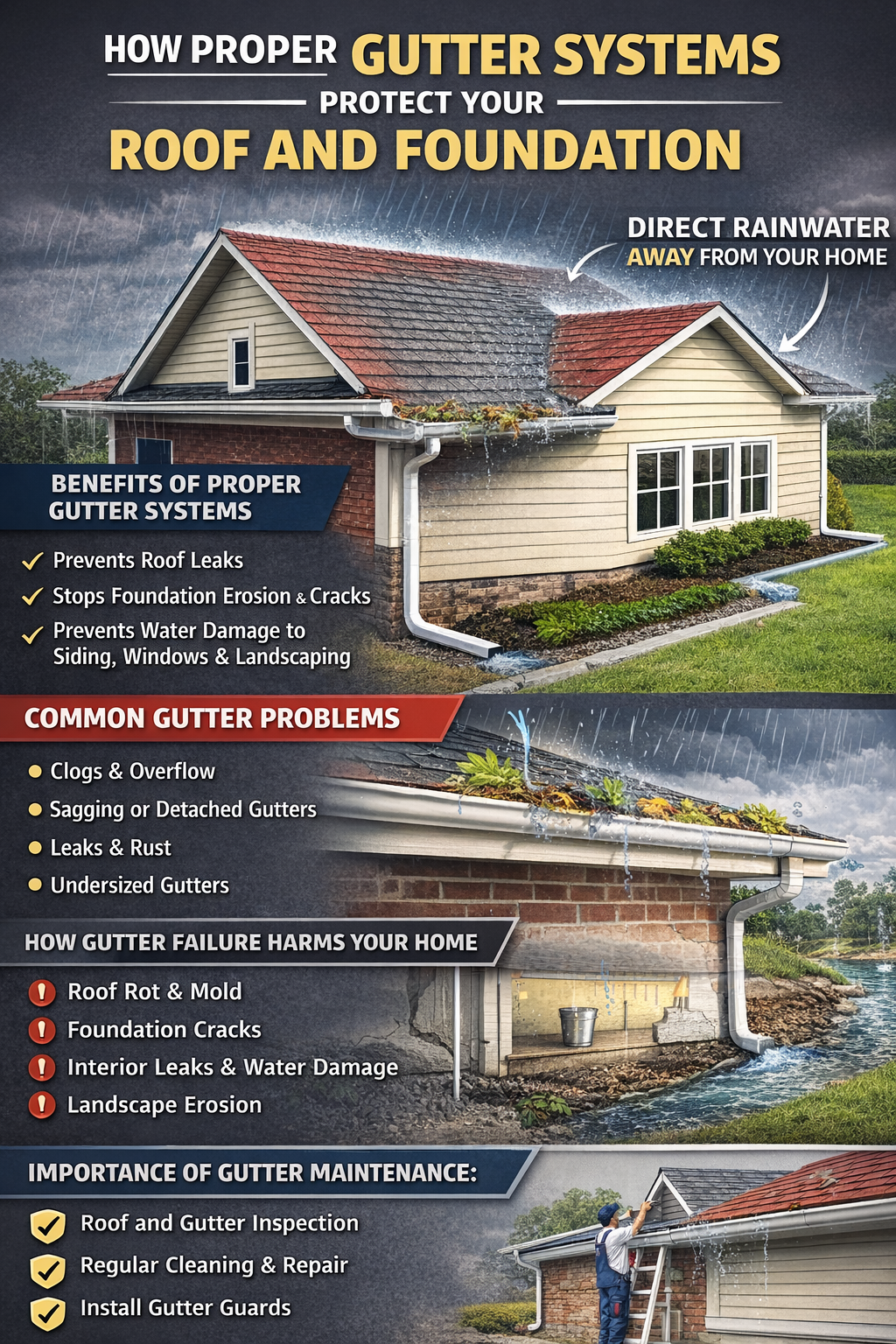
Gutters are designed to collect rainwater from the roof and direct it safely away from the home. Without this controlled drainage, water cascades off the roof edge, saturating soil near the foundation and placing stress on roofing materials.
Over time, uncontrolled water flow can erode roofing edges, rot fascia boards, weaken soffits, and cause foundation settlement. A functional gutter system ensures that water is diverted away from vulnerable areas, reducing the risk of structural deterioration.
How Gutters Protect Roof Edges
The roof edge assembly—fascia boards, soffits, and drip edge—takes constant abuse from water exposure. Gutters provide the first line of defense by capturing runoff before it can saturate these components.
When gutters overflow or pull away from the fascia, water runs directly down the face of the fascia board. Wood fascia absorbs this moisture, leading to rot that spreads into rafters and roof sheathing. Aluminum or vinyl fascia resists rot but can still trap moisture behind it if gutters aren’t properly sealed.
Soffits suffer when overflowing gutters splash water upward or when backed-up water finds its way into the soffit cavity. Ventilated soffits are particularly vulnerable—moisture intrusion can reach attic spaces and insulation.
Properly installed and maintained gutters keep water moving away from the roof edge, protecting these components from the constant wet-dry cycles that cause deterioration.
How Gutters Protect Your Foundation
Foundation damage is one of the most expensive consequences of gutter failure. When rainwater is not directed away from the home, it pools around the foundation, increasing hydrostatic pressure against basement walls.
This pressure can cause cracks, bowing walls, and water intrusion into basements or crawl spaces. Repeated saturation and drying cycles also lead to soil movement, which can result in foundation settling or shifting.
Proper gutter systems work in conjunction with downspouts and extensions to move water several feet away from the home. This controlled drainage preserves the integrity of the foundation and prevents the soil erosion that leads to structural problems. The same principle applies to protecting entry door thresholds from water pooling—anywhere water concentrates against the structure, damage follows.
In Michigan, where clay soils are common, this protection is especially important. Clay expands when wet and contracts when dry, creating movement that stresses foundations. Keeping water away from the foundation minimizes this cycle.
Seamless vs. Sectional Gutters
Gutters are manufactured in two primary styles: seamless and sectional. Each has distinct characteristics that affect performance and longevity.
Sectional gutters come in pre-cut lengths that are joined together during installation. The seams where sections meet are the most common failure points—they can separate, leak, or collect debris over time. Sectional systems are less expensive upfront but typically require more maintenance and have shorter lifespans.
Seamless gutters are formed on-site from continuous rolls of metal, custom-cut to the exact length needed for each run. With seams only at corners and downspout connections, there are far fewer potential leak points. Seamless systems cost more initially but generally last longer and require less ongoing repair.
For Michigan homes dealing with heavy rainfall, snow load, and freeze-thaw cycles, seamless gutters typically offer better long-term value. The reduced seam count means fewer opportunities for water intrusion and ice-related damage.
Gutter Materials: Aluminum, Copper, and Vinyl
The material you choose for gutters affects durability, maintenance requirements, appearance, and cost.
Aluminum is the most common gutter material for residential applications. It’s lightweight, rust-resistant, and available in a wide range of colors. Aluminum gutters can be painted to match trim and typically last 20-30 years with proper maintenance. They handle Michigan’s temperature swings well, though they can dent from impact.
Copper gutters are premium products valued for their appearance and longevity. Copper develops a distinctive patina over time and can last 50 years or more. The material is naturally antimicrobial, reducing organic buildup. However, copper costs significantly more than aluminum and requires specialized installation. It’s most commonly seen on historic homes or high-end construction.
Vinyl gutters are the least expensive option and easiest to install. They don’t rust or corrode and never need painting. However, vinyl becomes brittle in cold temperatures and can crack during Michigan winters. UV exposure also degrades vinyl over time, causing fading and reduced flexibility. Vinyl gutters typically have the shortest lifespan—often 10-15 years in northern climates.
For most Michigan homes, aluminum offers the best balance of performance, durability, and cost. Copper makes sense for specific architectural styles or homeowners prioritizing longevity over budget. Vinyl is generally not recommended for climates with significant freeze-thaw exposure.
Gutter Sizing for Michigan Rainfall
Standard residential gutters come in two common sizes: 5-inch and 6-inch profiles. Selecting the right size depends on roof area, pitch, and local rainfall intensity.
A 5-inch K-style gutter handles approximately 5,500 square feet of roof drainage in moderate rainfall. This is adequate for many smaller homes or sections of roof with limited collection area.
A 6-inch gutter handles roughly 7,900 square feet—over 40% more capacity than the 5-inch profile. For larger roofs, steep pitches that accelerate water flow, or areas with heavy tree coverage that increases debris load, 6-inch gutters provide necessary capacity.
Michigan receives an average of 30-35 inches of precipitation annually, with significant variation across the state. Jackson County and surrounding areas see concentrated rainfall during spring and summer storms that can overwhelm undersized gutters.
When gutters overflow during heavy rain, the excess water defeats the entire purpose of the system—it cascades over the edge and saturates the areas gutters are meant to protect. Proper sizing prevents this overflow and ensures consistent performance during peak demand.
Downspout sizing must match gutter capacity. Standard 2×3-inch rectangular downspouts pair with 5-inch gutters. Larger 3×4-inch downspouts are appropriate for 6-inch systems or high-volume drainage situations.
Gutter Guards: Types and Benefits
Gutter guards reduce debris accumulation and minimize maintenance frequency. Several types are available, each with distinct characteristics.
Screen guards are the simplest and least expensive option. Metal or plastic mesh covers the gutter opening, blocking leaves while allowing water through. Screens work well for large debris but can clog with small particles like shingle granules or pine needles. They require periodic cleaning and may need replacement every few years.
Surface tension (reverse curve) guards use a curved cover that directs water into the gutter while debris falls off the edge. These work well for leaves but can struggle with heavy rainfall—water may overshoot the opening during intense storms. Installation requires precise positioning, and some designs are visible from ground level.
Micro-mesh guards combine a solid cover with fine mesh screening. They block virtually all debris while maintaining water flow. Micro-mesh systems are among the most effective options but cost more than screens or surface tension designs. High-quality versions handle heavy rainfall well and require minimal maintenance.
Foam inserts fill the gutter channel, allowing water to flow through while blocking debris on top. They’re inexpensive and easy to install but can deteriorate in UV exposure and may harbor mold or seeds. Most foam inserts need replacement every 2-3 years.
Brush guards consist of bristles that fill the gutter, trapping debris on top while water flows around them. They’re simple to install but can collect fine debris within the bristles, requiring periodic removal for cleaning.
For Michigan homes, micro-mesh or quality screen guards typically offer the best performance. Heavy tree coverage may still require some maintenance, but proper guards significantly reduce cleaning frequency and prevent the complete blockages that cause overflow and damage.
Downspout Placement and Drainage
Gutters collect water; downspouts deliver it safely away from the home. Proper placement and adequate capacity are essential for complete system performance.
Downspout spacing depends on gutter length and roof drainage patterns. As a general rule, one downspout should serve no more than 30-40 linear feet of gutter. Longer runs without adequate downspouts create overflow conditions during heavy rain, even when gutters are clean.
Placement should direct water away from high-traffic areas, landscaping that can’t tolerate concentrated flow, and any location where water might pool against the foundation. Corner downspouts often discharge toward walkways or driveways—extensions or underground drainage can redirect flow to better locations.
Downspout extensions are critical for foundation protection. A downspout that terminates at the foundation line deposits all collected roof water exactly where it causes the most damage. Extensions should carry water at least 4-6 feet from the foundation, with longer distances preferred where grade allows.
Underground drainage systems connect downspouts to buried pipes that discharge water at a safe distance from the home. These systems eliminate surface extensions that can be damaged by mowers or foot traffic and provide more complete water management. However, underground systems require proper installation with adequate slope and can clog if not protected by gutter guards or filters.
Splash blocks are a simple, low-cost option for surface drainage. Positioned beneath downspout outlets, they spread water flow and direct it away from the foundation. Splash blocks work adequately for light-duty applications but don’t move water as far as extensions or underground systems.
Gutter Maintenance Requirements
Routine maintenance is essential for gutter performance. Even well-designed systems fail when clogged with debris or damaged by neglect.
Cleaning frequency depends on tree coverage. Homes with overhanging trees may need gutter cleaning 3-4 times per year—after leaf drop in fall, again in late winter to clear accumulated debris, and after spring seed pods and summer storms. Homes without significant tree coverage may only need annual cleaning.
During cleaning, inspect for damage. Look for loose hangers, separated seams, corrosion, and sections that have pulled away from the fascia. Check that gutters maintain proper slope toward downspouts—standing water indicates low spots that need correction.
Seal minor leaks at seams with appropriate gutter sealant. Replace damaged hangers before they allow entire sections to sag or fall. Clear downspouts completely—a clogged downspout backs up the entire gutter run it serves.
Spring inspection should follow winter to identify any damage from ice, snow load, or freeze-thaw cycles. Fall cleaning before leaf drop prepares the system for the wettest months and prevents debris from sitting through winter.
Signs Your Gutters Need Repair or Replacement
Several indicators suggest that gutter repair or replacement is needed:
Visible sagging or pulling away from the fascia indicates hanger failure or fascia rot. This allows water to spill behind the gutter, damaging the areas it’s supposed to protect.
Water marks or staining beneath gutters suggest overflow or leaking seams. Check for blockages first; if gutters are clean but still overflow, they may be undersized or improperly sloped.
Peeling paint or rust spots on steel gutters indicate coating failure. Once corrosion begins, it accelerates. Small rust areas can be treated, but widespread corrosion usually means replacement is approaching.
Separated seams or visible gaps allow water to escape before reaching downspouts. Minor separations can be resealed, but repeated failures at the same location suggest the system is aging out.
Pooling water or debris lines inside gutters indicate improper slope. Gutters should drain completely between rains. Standing water breeds mosquitoes, accelerates corrosion, and adds weight that stresses hangers.
Erosion channels or foundation staining below gutter termination points suggest inadequate drainage extensions or downspout failure. Even if gutters are functioning, poor discharge management defeats their purpose.
When multiple issues appear simultaneously, replacement often makes more sense than repeated repairs. A system that’s failing in several locations will continue to develop problems.
How Gutters Work With Other Exterior Systems
Gutters don’t function in isolation. They’re part of an integrated exterior protection system that includes roofing, siding, and foundation drainage.
Water that escapes gutters can cause siding damage that leads to structural problems. Splash back from overflowing gutters stains and saturates siding, accelerating deterioration.
Entry doors positioned beneath roof valleys or corners often receive concentrated water flow. Proper gutter sizing and placement at these locations protects door frames and thresholds from excessive moisture exposure.
Foundation drainage, including grading and French drains, works with gutter discharge to move water away from the structure. Gutters handle roof runoff; site drainage handles ground water. Both systems must function together for complete protection.
Request an Evaluation
If you’ve noticed overflow, sagging, or other signs of gutter problems, addressing them now prevents the foundation and structural damage that follows. Request a free exterior evaluation to assess your gutter system’s current condition.
Conclusion
Proper gutter systems are essential for protecting both your roof and foundation from water-related damage. Understanding gutter materials, sizing, guard options, and maintenance requirements helps homeowners make informed decisions about their exterior drainage systems.
Ignoring gutter issues leads to fascia rot, foundation damage, and costly structural repairs. Matching gutter capacity to roof size, maintaining proper slope, ensuring adequate downspout drainage, and keeping the system clean all contribute to long-term performance. For Michigan homes facing heavy seasonal rainfall and freeze-thaw cycles, functional gutters are not optional—they’re essential infrastructure.
Frequently Asked Questions
How often should roof gutters be inspected?
Gutters should be inspected at least twice per year—in spring after winter weather and in late fall after leaf drop. Homes with heavy tree coverage may need more frequent inspection.
Can clogged gutters damage a roof?
Yes. Clogged gutters cause water backup that can saturate fascia boards, damage roof edge components, and in severe cases allow water to back up under roofing materials.
What size gutters do most Michigan homes need?
Most Michigan homes perform well with 5-inch gutters, but larger roofs, steep pitches, or areas with heavy tree coverage benefit from 6-inch systems that handle higher water volumes.
Are gutter guards worth the investment?
For homes with significant tree coverage, quality gutter guards reduce maintenance frequency and prevent the complete blockages that cause overflow and damage. They typically pay for themselves in reduced cleaning costs and prevented repairs.
How far should downspouts extend from the foundation?
Downspout extensions should discharge water at least 4-6 feet from the foundation. Underground drainage systems can carry water even farther, providing better protection for homes with challenging site conditions.