I remember a conversation with a homeowner in Grass Lake a few years back. We’d finished her roof, and she was happy with the work—but she kept glancing at her front door while we talked. Finally she said, “I know you guys do roofs, but do you know anyone who does doors? This one’s been drafty for years and I’m embarrassed every time someone knocks.”
That door told a story before she ever opened it. Faded paint, weathered edges, a gap at the threshold you could see daylight through. It was the first thing visitors saw. And it was costing her money every month in heating and cooling she didn’t need to lose.
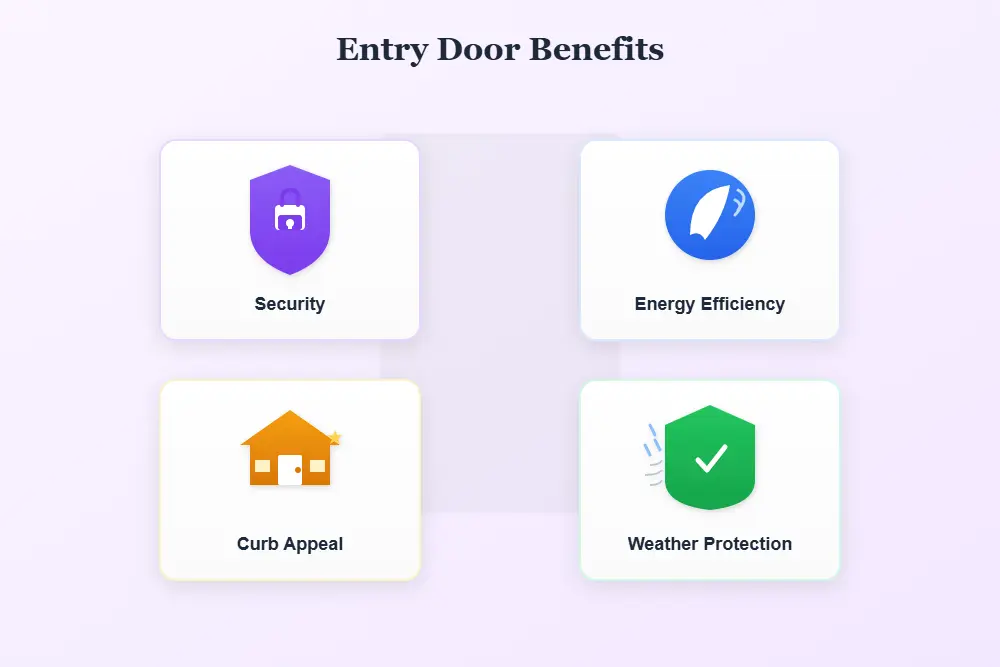
Entry doors don’t get the attention roofs do. Nobody panics about a door the way they panic about a leak. But the front door is the handshake your home gives everyone who approaches it. It’s security. It’s efficiency. It’s the thing standing between your family and whatever’s outside. When it stops doing its job well, you feel it—even if you can’t always name it.
This post covers what Jackson County homeowners should know about entry doors: the materials, the features, the signs it’s time for a change, and the details that separate a door that works from one that just fills a hole in the wall.
Entry Door Materials — Steel, Fiberglass, and Wood
The three main materials each come with trade-offs. There’s no single best choice—just the best choice for your situation.
Steel doors are the most affordable and the most secure. A steel door with a solid core is difficult to kick in, which is why they’re standard on most new construction. They’re also low-maintenance—no warping, no rotting, no need for regular refinishing. The downside is dents. Steel shows impact damage, and once it’s dented, the only fix is replacement. Steel also conducts temperature, so without good insulation in the core, it can feel cold in winter.
Fiberglass doors cost more but solve most of steel’s problems. They don’t dent, don’t conduct temperature as readily, and can be textured to look like real wood grain. High-quality fiberglass is nearly indistinguishable from wood at a glance. They resist Michigan weather well—no swelling in humidity, no cracking in cold. The trade-off is price and the fact that deep scratches can be harder to repair than on wood.
Wood doors are the classic choice. Nothing matches the warmth and character of real wood—the grain, the weight, the solid feel when it closes. But wood demands maintenance. It needs to be sealed or painted regularly, and even then, it can swell in humid summers and contract in dry winters. A wood door that fits perfectly in July might stick in August and gap in January. For covered entries with minimal weather exposure, wood can last beautifully. For doors that take direct sun and rain, fiberglass often makes more sense.
Most homeowners in Jackson County end up choosing between steel and fiberglass. Steel when budget matters most and security is the priority. Fiberglass when long-term durability, appearance, and energy efficiency are worth the higher upfront cost.
Storm Doors — When They Help and When They Don’t
A storm door is the outer door that protects your entry door from direct weather exposure. They’re common in Michigan, but they’re not always necessary—and in some cases, they can cause problems.
Storm doors help when your entry door faces harsh weather. If your front door gets direct afternoon sun in summer or takes the brunt of wind-driven rain and snow, a storm door acts as a buffer. It extends the life of your entry door by reducing UV exposure, moisture contact, and temperature extremes. In winter, it creates an air pocket between the two doors that adds insulation value.
Storm doors can hurt when paired with dark-colored entry doors in direct sun. The space between the doors can heat up dramatically—sometimes exceeding 150°F. That trapped heat can damage fiberglass doors, warp wood, and degrade weatherstripping. If you have a dark entry door with southern or western exposure, either skip the storm door or choose one with a retractable screen and low-E glass that blocks heat buildup.
Modern storm doors come with options: full glass for maximum light, retractable screens for ventilation, built-in blinds for privacy, and self-storing glass panels that slide out of the way in warm months. The hardware matters too—cheap storm doors rattle, sag, and fail within a few years. A well-built storm door with quality hinges and closers will last a decade or more.
Energy Efficiency Ratings — What the Numbers Mean
Entry doors come with energy ratings, and understanding them helps you compare options.
U-factor measures how well the door insulates. Lower is better. A U-factor of 0.30 or below is considered good for entry doors. The U-factor accounts for the entire door system—panel, frame, and glass if there’s a window.
Solar Heat Gain Coefficient (SHGC) measures how much solar heat passes through the door. Lower numbers mean less heat gain, which matters for doors with glass panels in direct sun. Higher SHGC can be beneficial for north-facing doors where passive solar heat is welcome in winter.
Energy Star certification means the door meets EPA standards for your climate zone. Michigan falls into the Northern climate zone, which has stricter requirements for insulation. An Energy Star door in Michigan needs a U-factor of 0.21 or lower—significantly better than the baseline.
The core material matters for efficiency. Polyurethane foam cores insulate better than polystyrene. A steel door with a polyurethane core can match or exceed the insulation value of a solid wood door while costing less. Fiberglass doors typically come with foam cores standard, which is part of why they perform well in cold climates.
Don’t overlook the weatherstripping and threshold. A door can have excellent core insulation and still leak air around the edges. Adjustable thresholds, compression weatherstripping, and proper installation matter as much as the door itself.
Security Features in Modern Entry Doors
A door is only as secure as its weakest point. Modern entry doors address security at every level.
The door itself: Steel and fiberglass doors with solid cores resist forced entry better than hollow-core or thin wood panels. Look for doors with reinforced edges around the lock area—this is where kick-ins typically succeed, by splitting the wood or bending the frame.
The frame: A strong door in a weak frame is still vulnerable. Reinforced strike plates with 3-inch screws that reach the wall studs—not just the door jamb—make a significant difference. Many break-ins succeed not because the door failed but because the frame did.
The lock: Deadbolts should have a minimum 1-inch throw—the length of the bolt that extends into the frame. Grade 1 deadbolts (the highest residential rating) withstand more force and more cycles than Grade 2 or 3. Smart locks add convenience but check the physical security rating, not just the technology features.
Glass: Doors with decorative glass can be weak points. Tempered glass is stronger than standard glass, and laminated glass (two layers with a plastic interlayer) resists shattering even when broken. If your door has glass within arm’s reach of the lock, consider impact-resistant glazing or a secondary deadbolt that can’t be reached through a broken pane.
Hinges: Outward-swinging doors expose hinge pins that can be removed. Security hinges with non-removable pins or setscrew hinges prevent this. Most residential entry doors swing inward, but if yours swings out, check your hinges.
Curb Appeal — The First Impression Your Home Makes
The front door is the focal point of your home’s exterior. Get it right and the whole house looks sharper. Get it wrong and everything else fades.
Color matters more than most people realize. A door that contrasts with the siding draws the eye and creates visual interest. A door that matches everything disappears. Bold colors—deep reds, navy blues, forest greens—make a statement. Classic black or white never goes out of style. The key is choosing intentionally, not defaulting to whatever was there before.
Style should fit the house. A modern slab door looks wrong on a colonial. An ornate Victorian door looks wrong on a ranch. Glass panels, raised panels, craftsman-style planks—each sends a signal about the home’s character. The best upgrades feel like they’ve always belonged.
Hardware is the finishing touch. Matching the door handle, deadbolt, and kick plate creates a cohesive look. Mixing metals or styles can work if it’s intentional, but mismatched hardware from different decades looks like neglect. This is also an opportunity to upgrade security without changing the door—a new Grade 1 deadbolt set replaces a worn-out lock and refreshes the appearance at the same time.
Don’t forget scale. A house with a grand entrance can handle an 8-foot door or a double door. A modest home with a small porch looks better with a standard 6’8″ door in proportion to its surroundings. Oversized doors on undersized homes look like a costume. The goal is harmony.
Door Sizing, Fit, and Installation Considerations
A door that doesn’t fit properly will never perform properly. Sizing and fit determine whether you get the efficiency, security, and longevity the door was designed to deliver.
Standard entry door sizes are 36 inches wide by 80 inches tall, but older Jackson County homes—especially those built before 1970—often have non-standard openings. Measuring the rough opening accurately before ordering a door prevents expensive surprises. The rough opening should be about 2 inches wider and 2.5 inches taller than the door to allow for shimming and adjustment.
Pre-hung doors come with the frame attached—they’re easier to install and ensure the door and frame are matched correctly. Slab doors are just the door itself, fitted into an existing frame. Slab replacements work when the frame is in good condition and the sizing matches exactly. When the frame is damaged, out of square, or rotting, pre-hung is the better choice even though it’s more work.
Thresholds deserve attention. The threshold is where most air and water infiltration occurs. Adjustable thresholds let you fine-tune the seal as the door settles or seasonal swelling changes the gap. A door that sweeps cleanly against a good threshold will outperform a door with a worn or poorly fitted one.
Installation quality determines outcome. A premium door installed poorly will leak, stick, and fail faster than a mid-range door installed correctly. Proper shimming, level and plumb alignment, correct hardware placement, and careful weatherstripping installation aren’t glamorous—but they’re what separates a door that works from one that fights you every day.
Signs Your Entry Door Needs Replacement
Doors don’t fail all at once. They decline slowly, and homeowners adjust without noticing. Here’s what to watch for:
✔ Visible daylight around the edges. If you can see light around a closed door, air is moving through that gap. Weatherstripping can address minor gaps, but if the door or frame is warped, replacement is the real fix.
✔ Difficulty opening or closing. Sticking, scraping, or needing to lift the door to latch it means something has shifted. Humidity swelling in wood doors is normal and seasonal. Permanent sticking in any material suggests the door or frame is no longer square.
✔ Drafts you can feel. Stand by your closed door on a cold, windy day. If you feel air movement, the seal has failed somewhere. Check the threshold, the weatherstripping, and the door’s fit in the frame.
✔ Condensation or frost between glass panes. If your entry door has insulated glass and moisture appears between the layers, the seal has broken. That glass unit is no longer insulating and needs replacement—sometimes just the glass, sometimes the whole door.
✔ Visible damage. Cracks in fiberglass, dents in steel, rot in wood, rust around hardware—any of these compromise function, security, or appearance. Minor damage can sometimes be repaired, but extensive damage usually means it’s time.
✔ Rising energy bills with no other explanation. If your heating or cooling costs have climbed and you’ve ruled out other causes, the building envelope is leaking somewhere. Doors and windows are common culprits.
If you’re nodding at several of these, the door is telling you something. Weatherstripping and adjustment can extend its life, but they can’t fix fundamental failure.
Hardware, Locks, and the Details That Matter
The door gets the attention, but hardware makes it work. Cheap hardware on a good door creates frustration. Quality hardware on any door creates satisfaction.
Handlesets range from basic lever-and-deadbolt combinations to decorative sets with thumb latches, grip handles, and integrated smart locks. Function matters more than style—test the action before committing. A handle that feels flimsy in the showroom will feel worse after 10,000 cycles.
Deadbolts should be Grade 1 for maximum security, Grade 2 for most residential applications. Grade 3 is builder-minimum and fine for interior doors, but not ideal for entry. Single-cylinder deadbolts (key outside, thumb turn inside) are standard. Double-cylinder deadbolts (key on both sides) add security but create fire safety concerns—you need a key to exit.
Smart locks offer keyless entry, remote access, and activity logs. They’re convenient for families, rental properties, and anyone who’s ever been locked out. Battery life varies—check how the lock fails when power dies. The best smart locks default to manual key operation as backup.
Hinges are invisible when the door is closed but critical to function. Ball-bearing hinges operate smoothly and handle heavy doors without sagging. Spring hinges self-close—useful for storm doors or when you want the door to pull shut automatically. Choose a finish that matches your other hardware.
Kick plates, mail slots, door knockers, and peepholes are personal choices. They don’t affect function, but they complete the look. If you’re replacing the door, it’s the right time to upgrade these details too.
Entry doors are one of those projects that seems simple until you start looking at the options. Materials, efficiency, security, appearance, sizing—every choice connects to the others. But when it’s right, you’ll know. The door will close with a solid sound, the drafts will be gone, and you won’t think about it again for years. That’s how it should be.
We’ve helped Jackson County homeowners with entry doors, storm doors, and other exterior improvements for over 30 years. If you’re not sure where to start, we’re happy to walk through the options with you—no pressure, just honest answers about what makes sense for your home.
Frequently Asked Questions
How long do entry doors typically last?
Steel and fiberglass doors last 20 to 30 years or more with proper maintenance. Wood doors can last just as long but require more regular upkeep—sealing, painting, and adjusting for seasonal movement. The hardware often wears out before the door itself.
Is a storm door worth the extra cost?
It depends on your entry door’s exposure. If your door faces direct weather—sun, rain, wind—a storm door extends its life and adds insulation value. If your door is protected by a deep porch or overhang, the benefits are smaller. Avoid pairing storm doors with dark-colored entry doors in direct sun.
What’s the most energy-efficient entry door material?
Fiberglass with a polyurethane foam core typically delivers the best energy performance. Steel with foam core is close behind and costs less. Wood doors vary widely—solid wood insulates reasonably well, but air leakage around the edges often offsets the material’s insulation value.
Can I replace just the door or do I need a new frame too?
If your frame is in good condition—square, solid, and not rotted—you can replace just the door (a slab replacement). If the frame is damaged, out of square, or deteriorating, a pre-hung door with a new frame is the better investment. Trying to fit a new door into a failing frame creates ongoing problems.
How much does a new entry door cost?
Entry doors range widely. A basic steel door starts around $200-400 for the door itself. Mid-range fiberglass doors run $500-1,500. High-end wood or custom doors can exceed $3,000. Installation adds $300-800 depending on complexity. Storm doors add $150-600 plus installation. These are general ranges—specific features, sizes, and local factors affect final pricing.