
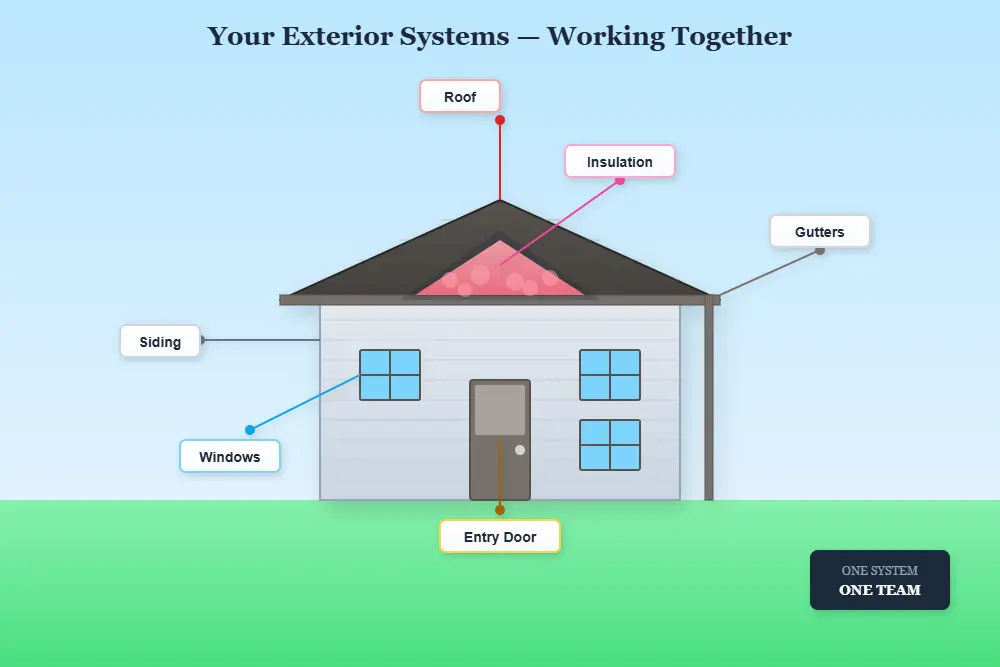
According to the National Association of Realtors, exterior projects consistently deliver the highest return on investment of any home improvement category. Garage door replacement recovers over 100% of its cost at resale. Siding, windows, and entry doors all rank in the top ten. The pattern is clear: what people see from the street shapes what they’re willing to pay.
But return on investment is only part of the story.
The exterior of your home is a system. Siding protects the structure from moisture. Gutters channel water away from the foundation. Windows and doors control air flow and energy loss. Insulation keeps conditioned air where it belongs. When one component fails, it stresses the others. When they work together, the whole house performs better—and lasts longer.
This post covers exterior home improvement from a systems perspective: how to assess what your home needs, how to prioritize projects for maximum impact, and why the order and timing of upgrades matters more than most homeowners realize.
The Whole-House Exterior Assessment
Before planning any exterior project, walk around your home with fresh eyes. Most homeowners stop noticing problems they see every day. A deliberate assessment catches what familiarity hides.
Start with the envelope—the barrier between inside and outside. Look at siding for cracks, warping, gaps, or areas where caulk has failed. Check window frames for rot or separation from the wall. Examine door weatherstripping for compression or gaps. Look at the foundation line where siding meets concrete—this transition point often fails first.
Move to water management. Follow the path water takes from sky to ground. Gutters, downspouts, splash blocks, grading—each step should move water away from the structure. Staining on siding below gutters suggests overflow. Erosion near downspouts suggests inadequate drainage. Moisture in the basement suggests the system isn’t working.
Check ventilation points. Soffit vents, gable vents, exhaust vents from bathrooms and kitchens—all should be clear and functional. Blocked or damaged vents create moisture problems that show up months or years later as mold, rot, or ice dams.
Finally, assess from the street. Stand where visitors and potential buyers stand. What do you notice first? Faded siding? Mismatched repairs? A front door that doesn’t fit the house? The curb view reveals what needs attention for both function and appearance.
Write down everything you observe. You’re building a project list, not committing to a timeline. The assessment tells you what exists. The prioritization tells you what to do first.
Prioritizing Exterior Projects for Maximum Impact
Not all projects are equal. Some protect the structure. Some improve efficiency. Some boost appearance. The best sequence addresses all three—but protection comes first.
Priority 1: Stop active damage. Water infiltration, pest entry points, structural deterioration—anything causing ongoing harm needs immediate attention. A gutter that dumps water against the foundation is damaging the house every time it rains. That project can’t wait for a more convenient time.
Priority 2: Prevent future damage. If your siding is intact but aging, your windows seal but inefficiently, your door works but drafts—these aren’t emergencies, but they’re heading that direction. Addressing them on your schedule costs less than addressing them after failure.
Priority 3: Improve performance. Energy efficiency upgrades, ventilation improvements, insulation additions—these enhance how the house functions day to day. They save money over time, improve comfort immediately, and often qualify for rebates or tax credits.
Priority 4: Enhance appearance. Curb appeal projects matter for enjoyment and resale value, but they shouldn’t jump the line ahead of protection or performance. A beautiful front door on a house with failing gutters is a misplaced priority.
The mistake homeowners make is starting with what’s visible instead of what’s critical. The cost of delaying small repairs compounds quickly—a $200 fix this year becomes a $2,000 problem next year. Address the urgent, then the important, then the desirable.
Curb Appeal ROI by Project Type
If resale value matters—and for most homeowners it does—some projects deliver more return than others. Here’s what the data shows:
| Project | Typical Cost Recovery | Notes |
|---|---|---|
| Garage Door Replacement | 100%+ | Highest ROI exterior project nationally |
| Manufactured Stone Veneer | 90-95% | Accent on front facade only |
| Entry Door Replacement | 85-90% | Steel doors recover more than fiberglass |
| Siding Replacement | 75-85% | Fiber cement outperforms vinyl for recovery |
| Window Replacement | 65-75% | Energy savings add to financial return |
These numbers represent national averages. Jackson County values may vary based on local market conditions, buyer preferences, and the specific quality of work. The pattern holds: projects visible from the street recover more than projects hidden from view.
But ROI isn’t the only consideration. A project that recovers 70% of its cost but prevents $5,000 in structural damage has a different value equation than the percentages suggest. Protect first, then maximize return.
Energy Efficiency Gains from Exterior Upgrades
Every exterior component affects energy performance. Upgrading strategically can significantly reduce heating and cooling costs.
Windows are often the biggest opportunity. Single-pane windows and older double-pane units with failed seals leak conditioned air constantly. Modern low-E, argon-filled windows can cut window-related heat loss by 30-50%. In Michigan, where heating dominates energy costs, window upgrades often pay for themselves within 10-15 years through utility savings alone.
Entry doors matter more than their size suggests. A standard 36-inch door with poor weatherstripping can leak as much air as a 6-inch hole in your wall. Upgrading to an insulated entry door with proper sealing improves comfort immediately and reduces the load on your HVAC system.
Siding provides an opportunity for added insulation. When replacing siding, adding a layer of rigid foam insulation underneath improves the thermal envelope without changing the interior. This approach is cost-effective during siding replacement and nearly impossible to retrofit later.
Attic insulation isn’t visible from outside, but it’s part of the exterior system. Heat rises, and an under-insulated attic lets that heat escape in winter—then absorbs it in summer. Proper attic insulation is often the highest-ROI energy upgrade available, with payback periods as short as 2-3 years.
Air sealing ties everything together. Insulation slows heat transfer; air sealing stops air movement. Caulking gaps around windows, sealing penetrations in the envelope, and ensuring weatherstripping is intact can reduce energy waste by 10-20% with minimal cost. The best time to air seal is during other exterior work, when materials are already out and access is easy.
One Contractor vs. Multiple Contractors
When multiple exterior projects need attention, homeowners face a choice: hire specialists for each trade, or find one contractor who handles several.
There are arguments for specialists. A company that only installs windows may have deeper expertise in that specific product. They’ve seen more edge cases, solved more unusual problems, and developed more refined techniques. For complex or high-end installations, specialist expertise can matter.
There are stronger arguments for consolidation. Exterior systems interact. The flashing where siding meets windows, the integration between gutters and fascia, the weatherstripping where doors meet frames—these transitions are where problems occur. A single contractor who understands all the components can ensure they work together. Multiple contractors mean multiple handoffs, and handoffs are where details fall through.
Scheduling becomes simpler. One contractor coordinates one timeline. Multiple contractors mean coordinating multiple schedules, managing multiple contracts, and potentially dealing with finger-pointing when something goes wrong at a transition point.
Cost often favors consolidation. Mobilization, setup, and project management costs spread across multiple projects instead of duplicating for each one. A contractor already on-site for siding can address a door or window at lower incremental cost than starting a separate project from scratch.
The key is finding a contractor with genuine capability across the services you need—not one who subs everything out and adds markup without adding value. Ask how much of the work their own crews perform. Ask about their experience with the specific products and transitions involved. Consolidation works when the contractor has real multi-trade capability. It doesn’t work when they’re just a general contractor farming out every task.
Timing Exterior Projects for Efficiency
Doing related projects together saves money, reduces disruption, and produces better results. The question is which projects benefit from bundling.
Siding and windows pair naturally. Proper window installation requires attention to flashing and integration with the wall system. When siding is already being removed, window replacement becomes easier and the transitions can be done correctly the first time. Doing windows after new siding is installed means disturbing finished work.
Gutters and fascia go together. Gutters attach to fascia boards. If the fascia is rotted or damaged, installing new gutters on bad fascia creates a short-term fix that fails again. Replacing fascia while gutters are down—or replacing both together—addresses the whole system.
Entry doors and storm doors should be considered as a pair. If both need replacement, doing them together ensures proper fit and alignment. A new storm door on an old, out-of-square entry frame won’t seal correctly.
Insulation and air sealing multiply each other’s effectiveness. Insulation without air sealing still lets air move through gaps. Air sealing without insulation still lets heat conduct through materials. Doing both during the same project produces results greater than either alone.
The worst approach is piecemeal work over years with no coordination. Each project disturbs what came before, transitions never get addressed properly, and the cumulative cost exceeds what planned, sequenced work would have cost. If budget requires phasing, at least plan the phases so each project sets up the next one correctly.
Budgeting for Comprehensive Exterior Upgrades
Exterior improvements are significant investments. Planning financially makes the difference between a successful project and a stressful one.
Get real numbers before deciding. Online cost estimators give ranges so wide they’re nearly useless. A window replacement “costs $300-1,500 per window” tells you nothing about your house. Get actual quotes from contractors who’ve seen your specific situation. Multiple quotes establish a realistic range.
Prioritize within your budget. If the full scope exceeds what you can spend, return to the priority framework: protection first, prevention second, performance third, appearance fourth. A smaller project done right beats an ambitious project done cheaply.
Consider financing strategically. Home equity loans and lines of credit often offer lower rates than personal loans or credit cards. Some energy efficiency upgrades qualify for special financing programs, rebates, or tax credits. Michigan has programs for insulation and window upgrades that reduce out-of-pocket costs. Ask contractors what programs apply to your project.
Build in contingency. Exterior projects reveal hidden problems—rot behind siding, failed flashing under windows, structural issues masked by cosmetic surfaces. A 10-15% contingency buffer prevents budget overruns from derailing the project.
Compare total cost, not just price. The lowest bid isn’t always the best value. What’s included? What warranties are offered? What’s the contractor’s track record for completing projects on budget? A bid that’s 15% lower but excludes critical details or comes from a contractor with callback problems isn’t actually cheaper.
Think in timelines, not just dollars. A phased approach over 2-3 years may be more manageable than trying to do everything at once. If phasing, sequence projects logically—don’t install new windows before replacing the siding that surrounds them.
The Systems Perspective
Exterior home improvement isn’t a list of separate projects. It’s the care and feeding of a system that protects everything inside from everything outside. Every component interacts with every other component. Water, air, heat, and pests all look for the weak point—and the weak point is usually a transition, a gap, or a component that failed before its neighbors.
The homeowners who get the best results are the ones who think about the whole before focusing on the parts. They assess before they act. They prioritize protection over appearance. They time projects to reinforce each other instead of undoing previous work. They find contractors who understand systems, not just products.
That’s what exterior home improvement looks like when it’s done right. Not a series of reactions to problems, but a strategy that protects your home and your investment for the long term.
Frequently Asked Questions
What exterior home improvement should I do first?
Start with whatever is actively causing damage—water infiltration, pest entry, structural deterioration. If nothing is urgent, prioritize projects that prevent future damage over projects that enhance appearance. Protection first, curb appeal second.
How much does a full exterior renovation cost?
Comprehensive exterior work—siding, windows, doors, gutters—typically runs $30,000-$80,000 for an average Jackson County home, depending on materials and scope. Individual components vary widely. Get project-specific quotes rather than relying on ranges.
Is it better to do all exterior projects at once or phase them?
Doing related projects together saves money and produces better results at transitions. If budget requires phasing, sequence logically: siding before windows, fascia before gutters, structure before cosmetics. Plan the phases even if you execute them over time.
How do I know if my contractor can handle multiple exterior trades?
Ask what percentage of work their own crews perform versus subcontractors. Ask for references from projects that included multiple components. Ask specifically about transitions—how they handle the integration between siding and windows, gutters and fascia, doors and frames.
What exterior upgrades add the most home value?
Garage doors, entry doors, and siding consistently show the highest cost recovery at resale—often 80-100% of project cost. But value depends on your starting point. Fixing a failing component recovers more than upgrading a functional one.
When is the best time of year for exterior home improvement?
Late spring through early fall offers the best weather for most exterior work in Michigan. Siding, windows, and doors install best in moderate temperatures. Some projects—like insulation—can happen year-round. Schedule major exterior work to complete before winter weather arrives.