

There is a moment most homeowners remember clearly: the first time they notice something small on the outside of their home that feels easy to ignore. A thin crack near a window. A door that sticks slightly when it rains. Paint peeling just enough to catch the eye, but not enough to cause alarm. At that moment, the decision feels harmless. Fix it later. Watch it for now. After all, it’s only a small exterior issue. That single decision is where thousands of dollars are either saved—or quietly lost.
Exterior home repairs are rarely about dramatic failures. They are about slow changes, subtle damage, and problems that develop patiently while life goes on inside the house. By the time exterior damage becomes obvious, it has usually moved beyond the surface. This is why small exterior repairs done early almost always cost a fraction of what delayed repairs demand later.
This article looks beyond generic maintenance advice. It explains how exterior damage truly spreads, why certain areas fail faster than others, and how addressing minor exterior house repairs early protects not just your home’s appearance, but its structure, efficiency, and long-term value.
The Stitch in Time Principle for Home Exteriors
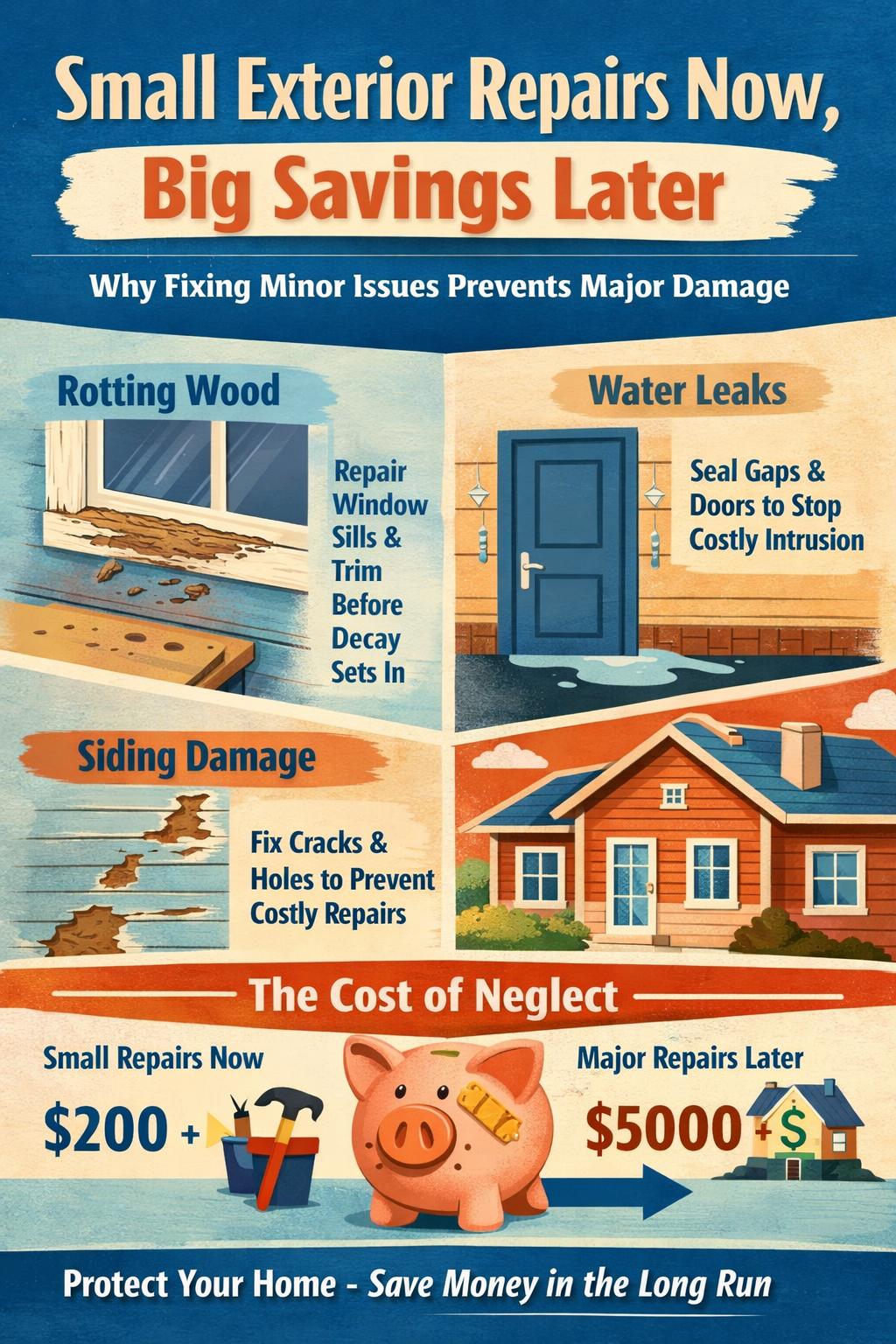
The old saying applies perfectly to exterior maintenance: a stitch in time saves nine. A $50 tube of caulk applied around a window frame today can prevent $5,000 in wall repairs two years from now. A $200 threshold replacement can save $2,000 in subfloor damage. The math is never close.
Small exterior home repairs work because they address problems while they’re still isolated. Once damage spreads—once moisture reaches framing, once rot sets into structural wood, once one failing component stresses another—the repair scope multiplies. The original problem becomes the least expensive part of the fix.
This isn’t about being paranoid. It’s about understanding that exterior systems are interconnected. A worn seal doesn’t just let water in at one spot. That water travels, pools, and finds the path of least resistance into places never meant to get wet.
How Neglect Compounds: One Problem Causes Another
Exterior damage rarely stays contained. A small gap around a window frame allows water intrusion. That moisture seeps into the wall cavity and saturates insulation. Wet insulation loses effectiveness and holds moisture against wooden studs. The studs begin to rot. Mold finds ideal growing conditions. What started as a minor seal failure now requires wall removal, mold remediation, insulation replacement, and structural repairs.
The same chain reaction applies across exterior systems. Peeling paint exposes wood to moisture absorption. The wood swells and contracts with temperature changes, cracking further. Cracks allow more moisture penetration. The cycle accelerates until the entire component needs replacement rather than simple maintenance.
Understanding this compounding effect changes how homeowners think about small repairs. The question isn’t whether you can afford to fix something now—it’s whether you can afford the cascade of damage that follows if you don’t.
The Cost Escalation Math
Minor exterior fixes and major replacements occupy completely different financial categories. Here’s how the math typically works:
Recaulking a window: $30-75. Replacing rotted window framing and surrounding wall section: $1,500-4,000.
Repainting exposed trim: $100-300. Replacing rotted trim boards plus underlying sheathing damage: $800-2,500.
Replacing a worn door threshold: $150-300. Repairing water-damaged subfloor, framing, and flooring inside the entrance: $2,000-6,000.
Sealing gaps around exterior penetrations: $50-150. Addressing moisture damage, mold growth, and insulation failure behind walls: $3,000-10,000.
These aren’t exaggerated scenarios. They represent the actual cost difference between catching problems early and discovering them late. The early repair is scheduled, planned, and manageable. The late repair is urgent, invasive, and expensive.
Prioritizing Repairs: What to Fix First
Not all exterior issues carry equal urgency. When multiple problems exist, prioritize based on water exposure and structural risk.
Fix first: Anything that allows water entry. Failed caulking around windows and doors, cracked seals, gaps where different materials meet, and damaged flashing should be addressed immediately. Water damage accelerates faster than any other type of deterioration.
Fix second: Components showing early signs of material failure. Soft spots in wood, bubbling paint, minor cracks, and areas where finishes are wearing thin. These indicate that protective barriers are breaking down but damage hasn’t yet spread.
Fix third: Cosmetic issues that don’t yet affect function. Faded paint on protected surfaces, minor surface weathering, and aesthetic wear. These matter for appearance and long-term protection but aren’t causing active damage.
This priority system helps homeowners make smart decisions when budgets are limited. Addressing high-priority items first prevents the expensive cascades while lower-priority items can wait for the next maintenance cycle.
Seasonal Maintenance Checklist for Exteriors
Exterior maintenance is most effective when tied to seasonal rhythms. Each season brings different stresses and reveals different vulnerabilities.
Spring: Inspect for winter damage. Look for cracked caulking around windows and doors, peeling paint from freeze-thaw cycles, and gaps that may have opened as materials contracted in cold weather. Check door thresholds and weatherstripping for wear. Clean debris from areas where moisture could collect.
Summer: Address paint and sealant work while conditions are ideal for curing. Inspect exterior wood for soft spots or discoloration that indicates moisture retention. Check that exterior surfaces drain properly after rain rather than holding water.
Fall: Prepare for winter by sealing any gaps, cracks, or openings that could allow moisture or cold air intrusion. Inspect areas where different materials meet—these joints are most vulnerable to seasonal movement. Ensure door and window seals are intact before heating season increases the pressure differential between inside and outside air.
Winter: Limit work to emergency repairs but continue visual inspections. Note ice dam locations, areas where snow accumulates against the house, and any signs of moisture intrusion for spring attention.
Following this cycle catches problems early and schedules repairs during optimal conditions for each type of work.
DIY Maintenance vs. Professional Inspection
Homeowners can handle many exterior maintenance tasks themselves. Recaulking windows and doors, repainting exposed surfaces, replacing weatherstripping, and sealing minor gaps all fall within typical DIY capabilities. These tasks require basic tools, readily available materials, and modest skill levels.
However, some situations call for professional assessment. Signs of structural involvement—soft or spongy wood, visible rot extending into framing, cracks in masonry, or evidence of moisture behind walls—require experienced evaluation. Professionals can assess whether damage is superficial or systemic, identify hidden problems, and recommend appropriate repair scope.
A practical approach combines both: homeowners perform regular maintenance and seasonal inspections while scheduling professional assessments annually or when warning signs appear. This keeps maintenance costs low while ensuring serious problems don’t go undetected.
The key distinction is this: if you’re unsure whether damage is cosmetic or structural, get a professional opinion before proceeding. The cost of an assessment is trivial compared to the cost of missing structural damage or making repairs that don’t address the real problem.
Budget Planning for Ongoing Maintenance
Exterior maintenance costs are predictable when approached systematically. Rather than facing unexpected emergency repairs, homeowners who budget for ongoing maintenance control both timing and expense.
A reasonable annual maintenance budget for exterior upkeep ranges from $500-1,500 for a typical home, depending on age, size, and material types. This covers routine caulking, paint touch-ups, weatherstripping replacement, and minor repairs. Setting aside this amount annually smooths costs over time and ensures funds are available when needs arise.
Larger cyclical expenses—full exterior repainting every 7-10 years, door or window weatherproofing system updates, or component replacements—can be anticipated and saved for separately. Knowing these cycles prevents surprise expenses and allows homeowners to schedule work conveniently rather than reactively.
The alternative to planned maintenance isn’t saving money. It’s converting small, predictable expenses into large, unpredictable ones. Deferred maintenance always costs more in the end.
Small Repair Examples That Prevent Big Expenses
Concrete examples make the principle clear. These are common scenarios where minor repairs prevent major damage:
A homeowner notices daylight visible around an entry door frame. Cost to replace weatherstripping and adjust the door: approximately $100-200. If ignored, the gap allows air leakage that stresses the HVAC system and permits moisture entry during wind-driven rain. Within two years, the subfloor near the entrance shows water damage and the framing is beginning to rot. Repair cost: $3,000-5,000.
Paint begins peeling on south-facing trim boards. Cost to scrape, prime, and repaint: approximately $150-400 depending on scope. If ignored, bare wood absorbs moisture and begins to deteriorate. Within 18 months, the trim boards are soft and rotting, and moisture has reached the sheathing behind them. Replacement cost: $1,200-2,800.
Caulking around a bathroom exhaust vent has cracked and separated. Cost to remove old caulking and reseal: approximately $20-50. If ignored, water enters behind the siding during every rain. Within one year, sheathing rot is underway. Within two years, wall cavity damage requires significant repair. Cost: $2,000-4,500.
These aren’t worst-case scenarios. They’re typical progressions when small problems are dismissed as unimportant.
Take Action Before Small Problems Grow
If you’ve noticed signs of wear on your doors, trim, or other exterior surfaces, addressing them now is the smartest financial decision you can make. Schedule a free exterior evaluation and get a clear picture of what needs attention—before minor repairs turn into major expenses.
Conclusion
Exterior home repairs may not feel urgent when the damage appears minor, but the long-term consequences of delay are almost always costly. From moisture intrusion and structural decay to energy loss and reduced property value, the risks compound over time.
The math is consistent: small repairs cost a fraction of the replacements they prevent. Seasonal maintenance catches problems early. Prioritizing by water exposure addresses the highest risks first. Budget planning makes costs predictable rather than surprising.
In home maintenance, timing matters. Small repairs today don’t just save money—they safeguard your home’s future.