Heat rises. That’s basic physics. And in a house, rising heat means one thing: your attic is where the most energy gets lost.
In Michigan, where heating costs dominate household energy budgets for six months of the year, attic insulation isn’t optional—it’s the single most cost-effective upgrade most homeowners can make. Proper insulation keeps heat inside during winter, keeps heat outside during summer, and pays for itself faster than almost any other home improvement.
Yet most Jackson County homes are under-insulated. Not by a little—by a lot. Homes built before 2000 often have half the insulation that current codes require. Even newer homes sometimes cut corners. The result is money literally escaping through the ceiling, month after month, year after year.
This post covers what you need to know about attic insulation: the types available, what R-value means and how much you need, how to tell if your attic is under-insulated, and what realistic energy savings look like. By the end, you’ll understand why this unsexy upgrade deserves priority on your home improvement list.
R-Value Explained — And What Michigan Homes Need
R-value measures thermal resistance—how well a material resists heat flow. Higher R-value means better insulation. It’s the standard measure for comparing insulation products.
R-value is additive. If you have R-19 insulation and add R-30 on top, you get R-49. This matters because upgrading existing insulation is often more practical than removing and replacing it. You build on what’s there.
For Michigan’s climate zone (Zone 5 in southern Michigan, Zone 6 in northern Michigan), the Department of Energy recommends R-49 to R-60 in attics. Jackson County falls in Zone 5, where R-49 is the minimum recommendation for new construction and upgrades.
Most older homes have far less. Homes built in the 1970s and 1980s commonly have R-19 to R-30. Homes from the 1950s and 1960s often have R-11 or less—sometimes just a thin layer of deteriorated batts or nothing at all. Even homes built in the 1990s frequently have only R-30 to R-38, below current recommendations.
The gap between what most homes have and what they should have represents real money. Every winter. Every summer. The insulation you’re missing is costing you.
Types of Attic Insulation
Three main types dominate residential attic insulation. Each has advantages depending on your situation.
Blown-in insulation (loose-fill) is the most common choice for attic floors. Cellulose or fiberglass is blown into the space using specialized equipment, filling gaps and conforming to irregular surfaces. It’s efficient to install over existing insulation, covers hard-to-reach areas, and provides excellent coverage when done correctly. Cellulose (made from recycled paper treated with fire retardant) and fiberglass are the two main materials. Both perform well; cellulose is slightly denser and may settle more over time.
Batt insulation consists of pre-cut fiberglass or mineral wool panels designed to fit between standard joist spacing. It’s what most people picture when they think of insulation—the pink or yellow fluffy rolls. Batts work well in open, accessible spaces with consistent joist spacing. They’re less effective in attics with obstacles, irregular framing, or limited headroom. DIY-friendly for simple installations, but achieving full coverage is harder than it looks.
Spray foam insulation expands on application, sealing gaps and providing both insulation and air barrier in one step. Closed-cell spray foam offers the highest R-value per inch (approximately R-6 to R-7 per inch versus R-3 to R-4 for other types). It’s excellent for sealing air leaks and works in spaces where other insulation can’t. The trade-off is cost—spray foam runs 2-3 times the price of blown-in or batts for equivalent R-value.
For most Jackson County attic floor applications, blown-in insulation offers the best combination of performance, cost, and ease of installation. Spray foam makes sense for specific applications: sealing rim joists, insulating cathedral ceilings, or addressing attics where air sealing is the primary goal.
Signs Your Attic Is Under-Insulated
You don’t need to climb into your attic to spot the signs of inadequate insulation. Your house tells you if you know what to listen for.
Uneven temperatures between rooms. If some rooms are comfortable while others are always too hot or too cold, insulation gaps are a likely cause. Heat and cold take the path of least resistance. Where insulation is thin, temperatures swing.
High heating and cooling bills. Compare your energy costs to similar homes or to previous years. If your bills keep climbing despite stable rates and usage patterns, the thermal envelope has likely degraded. Insulation settles, compresses, and loses effectiveness over time.
Ice dams in winter. When heat escapes through the attic, it warms the roof deck, melting snow from below. That melt refreezes at the cold eaves, forming ice dams that back water under shingles. Consistent ice dams indicate heat loss—and heat loss indicates inadequate insulation or ventilation.
Drafts and cold spots. If you feel cold air near ceilings or at the top of interior walls, conditioned air is escaping and unconditioned air is infiltrating. Insulation gaps create convection currents you can feel.
Your HVAC runs constantly. If your furnace or AC struggles to maintain temperature and cycles frequently, the house is losing conditioned air faster than the system can replace it. More insulation means less load on equipment.
The house feels different upstairs versus downstairs. Heat rises, so upper floors should be warmer—but if the upstairs is unbearably hot in summer and cold in winter, the attic isn’t insulating properly. The temperature extremes of the attic space are transferring through an inadequate barrier.
How to Check Your Current Insulation Levels
Before adding insulation, you need to know what you’re starting with. A quick inspection tells you where you stand.
Access your attic through the hatch, pull-down stairs, or access door. Bring a flashlight and a tape measure or ruler. If you have a finished attic, you’ll need to check at access points or inspect from an unfinished area if one exists.
Look at the insulation on the attic floor (between the joists, above your ceiling). Is it uniform or patchy? Are there areas with less coverage or no coverage? Gaps around hatches, HVAC equipment, plumbing penetrations, and electrical boxes are common.
Measure the depth. Fiberglass batts typically provide about R-3 per inch. Blown-in fiberglass provides roughly R-2.5 per inch. Cellulose provides about R-3.5 per inch. If you have 10 inches of blown-in fiberglass, you have approximately R-25. If you have 6 inches of old batts, you might have R-18 or less.
Check the condition. Insulation that’s compressed, water-stained, or deteriorated performs below its rated value. Old insulation that’s been walked on repeatedly may be compacted to half its original depth. Water damage indicates both reduced performance and potential mold issues.
Compare what you find to the R-49 recommendation. If you have R-25, you need to add R-24 to reach the target. If you have R-11, you need R-38 more. The gap tells you the scope of the project.
Energy Savings from Proper Attic Insulation
Insulation upgrades deliver measurable savings. The question is how much—and that depends on your starting point.
The Department of Energy estimates that air sealing and insulating an under-insulated attic can reduce heating and cooling costs by 10-20%. For a Jackson County home spending $2,400 annually on heating and cooling, that’s $240-480 per year in savings.
The savings are higher if you’re starting from a worse position. Upgrading from R-11 to R-49 produces more savings than upgrading from R-30 to R-49. Homes with major air leaks benefit from combined air sealing and insulation more than tight homes that just need insulation.
The math works best when you compare project cost to annual savings. A blown-in insulation project for an average attic might cost $1,500-3,000. At $300-400 annual savings, payback takes 4-8 years. After that, every year is pure return.
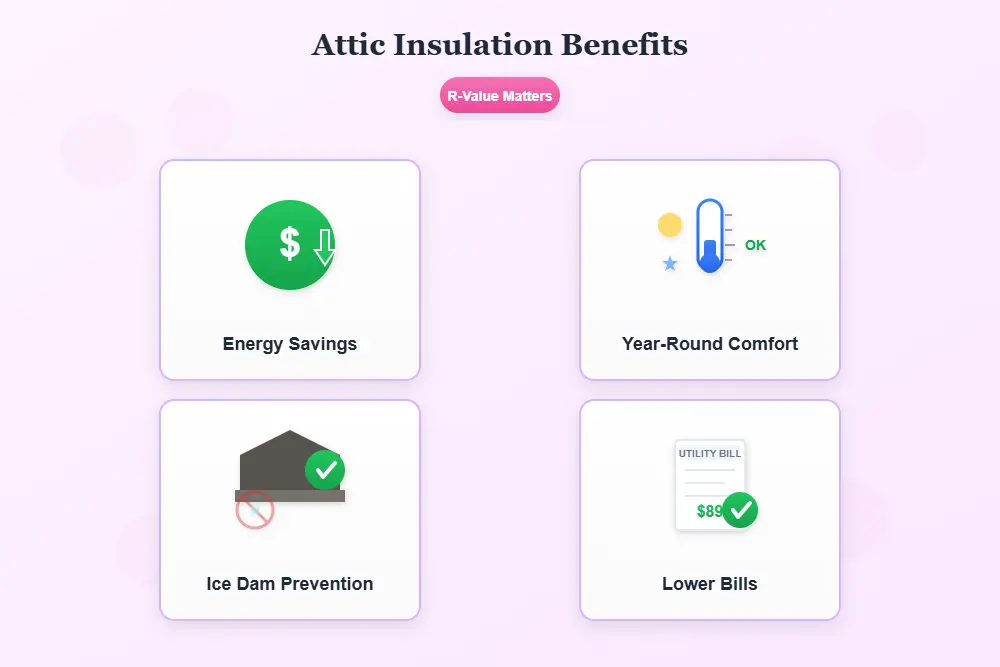
Energy savings aren’t the only benefit. Comfort improves immediately—fewer drafts, more consistent temperatures, less strain on HVAC equipment. Equipment lasts longer when it doesn’t have to work as hard. And efficient windows work even better when paired with adequate attic insulation—addressing the whole thermal envelope produces better results than fixing one component.
Insulation and Ventilation — Working Together
Insulation and ventilation seem like opposites—one keeps air in, the other lets air out. But they work together, not against each other.
Attic ventilation serves a specific purpose: it removes moisture and regulates attic temperature. In winter, ventilation carries moisture from the house out of the attic before it can condense on cold surfaces and cause mold or rot. In summer, ventilation exhausts hot air, reducing the load on air conditioning.
Insulation serves a different purpose: it slows heat transfer between the conditioned space below and the unconditioned attic above. The attic is supposed to be close to outdoor temperature—cold in winter, hot in summer. Insulation keeps that temperature from affecting your living space.
Problems occur when either system is compromised. Insulation without adequate ventilation traps moisture in the attic. Ventilation without adequate insulation lets conditioned air escape and unconditioned air affect the house. Both must work properly.
When adding insulation, don’t block soffit vents. Baffles installed in each rafter bay maintain airflow from soffit to ridge while allowing insulation to extend fully to the exterior walls. This detail matters—many DIY insulation jobs fail because they block ventilation paths.
If you’re seeing condensation, mold, or ice dams despite adequate insulation levels, ventilation is likely the issue. Addressing insulation alone won’t solve ventilation problems.
Ice Dam Prevention Through Insulation
Ice dams are a Michigan winter reality, but they’re not inevitable. Proper insulation is the primary defense.
Here’s the mechanism: heat escaping from the house warms the roof deck. Snow on the warm section melts. That water runs down toward the eaves—which are colder because they extend beyond the heated house. The water refreezes, creating a dam. More melt pools behind the dam, potentially backing under shingles and into the house.
The solution is keeping the roof deck cold. If no heat reaches the deck, no melting occurs from below. Consistent snow coverage actually indicates a well-insulated attic—the snow stays because the roof isn’t warm enough to melt it.
Insulation prevents heat from reaching the attic. Ventilation removes whatever heat does escape before it warms the deck. Together, they maintain a cold roof that doesn’t melt snow prematurely.
Air sealing matters as much as insulation for ice dam prevention. Heat travels with air movement—warm air leaking through ceiling penetrations, duct systems, or gaps around chimneys can warm the roof even with adequate insulation. Sealing those leaks keeps heat where it belongs.
If you’ve struggled with ice dams, start with insulation and air sealing before considering heat cables or other band-aid fixes. Addressing the cause works better than treating the symptom.
“The attic shouldn’t know what season it is inside the house. If it does, heat is escaping.”
Owens Corning Insulation — What We Use and Why
Not all insulation is equal. We use Owens Corning products because they perform reliably and carry strong warranties.
Owens Corning AttiCat is a blown-in fiberglass system designed specifically for attic applications. The expanding technology means the material fluffs up after installation, filling gaps and achieving target coverage more efficiently than older blow-in systems. It’s non-combustible, doesn’t settle as much as cellulose over time, and carries a lifetime limited warranty.
Owens Corning PINK Fiberglas batts remain a solid choice for specific applications—basement rim joists, framed cavities, and situations where blown-in isn’t practical. The material has been proven over decades. Pre-cut sizes reduce waste and installation time.
The pink color isn’t just branding—it’s recognition. When you see pink insulation in an attic, you know the material source and can reference the product specifications. That matters for warranty purposes and future work.
We chose Owens Corning because the performance matches the claims, the installation systems work efficiently, and the warranty provides real protection. There are other quality manufacturers, but Owens Corning’s consistency and availability in our area made them the right fit.
DIY vs. Professional Insulation Installation
Can you insulate your own attic? Sometimes. Should you? That depends on your situation.
DIY makes sense when:
You’re adding batts to an accessible, straightforward attic with consistent joist spacing and no obstacles. You can safely work in the space without stepping through the ceiling. You understand proper installation—full contact with air barriers, no gaps, no compression. And you value your time at a rate that makes the labor trade-off worthwhile.
Professional installation makes sense when:
Blown-in insulation is the right choice. The equipment for proper blown-in installation costs more to rent than hiring a professional costs, and the technique matters for coverage. Professionals achieve consistent depth and density; homeowners often create uneven coverage.
Air sealing is needed alongside insulation. Identifying and sealing air leaks requires experience. Professionals know where to look—top plates, plumbing penetrations, recessed lights, ductwork—and how to seal each type properly.
Access is limited or hazardous. Low headroom, unsafe footing, extreme temperatures, and physical demands make attic work difficult and dangerous. Falls through ceilings are common among DIYers.
The project is complex. Old insulation removal, mold remediation, electrical or HVAC conflicts, and structural issues all complicate insulation work beyond DIY scope.
For most whole-attic insulation projects, professional installation delivers better results at competitive cost. The home improvement stores that rent blow-in machines often quote equivalent material costs to what professionals charge for material plus labor. The difference is quality of execution.
Insulation Cost Factors
Attic insulation costs vary based on several factors. Understanding them helps you evaluate quotes.
Attic size is the baseline. Insulation is priced by square foot of coverage. A 1,000 square foot attic costs roughly half what a 2,000 square foot attic costs for the same specification.
Target R-value determines material quantity. Going from R-19 to R-49 requires more material than going from R-30 to R-49. Deeper insulation means more product.
Insulation type affects price per R-value. Blown-in fiberglass and cellulose are most economical. Batts cost similarly but require more labor for equivalent coverage. Spray foam costs 2-3 times as much per square foot.
Existing conditions matter. An empty attic with good access costs less than an attic full of stored items, old insulation to remove, or hazardous conditions to address. Preparation and cleanup add cost.
Air sealing scope varies by project. Basic air sealing at common penetrations adds modest cost. Extensive sealing at dozens of penetrations, ductwork, and structural gaps adds more.
For a typical Jackson County home with a 1,200 square foot attic, upgrading from R-19 to R-49 with blown-in fiberglass and basic air sealing typically runs $1,800-3,500. Smaller homes, simpler conditions, and higher starting R-values cost less. Larger homes, complex conditions, and lower starting points cost more.
Rebates and incentives reduce out-of-pocket cost. Utility companies, state programs, and federal tax credits often apply to insulation upgrades. Check current programs before committing—they change frequently but can reduce project cost by 10-30%.
Attic insulation isn’t glamorous. You can’t see it, visitors won’t notice it, and it won’t make the neighbors envious. What it will do is cut your energy bills, make your house more comfortable, protect your home from ice dams, and pay for itself faster than almost any other upgrade. Pair it with a well-insulated entry door and efficient windows, and the whole envelope works together. That’s worth doing.
Frequently Asked Questions
How long does attic insulation last?
Properly installed fiberglass insulation can last 80-100 years—essentially the life of the house. Cellulose lasts 20-30 years before settling reduces effectiveness. Real-world performance depends on conditions: moisture damage, pest activity, and compression from foot traffic all shorten lifespan.
Can I put new insulation over old insulation?
Usually yes. If existing insulation is dry, mold-free, and not contaminated by pests, you can add new material on top. The R-values are additive. If existing insulation is damaged, wet, or compromised, remove it first—adding good insulation over bad doesn’t fix the underlying problem.
How much does it cost to insulate a 1,500 square foot attic?
For blown-in fiberglass from R-19 to R-49 with basic air sealing, expect $2,200-4,000 professionally installed. DIY material cost runs $800-1,200 plus equipment rental, but results are typically less consistent. Exact pricing depends on local labor rates, access conditions, and current insulation levels.
Will adding attic insulation make my house too tight?
Unlikely. Attic insulation slows heat transfer; it doesn’t seal the house airtight. Air sealing at ceiling penetrations does reduce air exchange, but most homes have more air leakage than needed. True air quality concerns arise only in extremely tight new construction, not typical insulation upgrades.
Do I need to remove old insulation before adding new?
Only if the old insulation is damaged. Water stains, mold, pest contamination, or vermiculite (which may contain asbestos) all require removal before adding new material. Clean, dry, undamaged insulation—even if inadequate—can stay in place with new insulation added on top.
What R-value do I actually need in Jackson County?
R-49 is the current recommendation for attic floors in Zone 5, which includes Jackson County. R-38 is the minimum code requirement. Higher R-values provide diminishing returns—going from R-49 to R-60 saves less per dollar than going from R-19 to R-49. For most homes, R-49 is the practical target.