If you’ve ever filed a hail damage claim—or watched your neighbor file one while your roof stayed intact—you already understand why impact resistant shingles matter. What you might not understand is how they’re tested, what the ratings mean, and whether the price premium makes sense for your house.
Michigan isn’t tornado alley. But we get hail. Jackson County has seen multiple significant hailstorms in recent years, including events with hailstones large enough to crack standard shingles on contact. When that happens, the roof that looked fine yesterday suddenly needs replacing. The insurance claim gets filed, the deductible gets paid, and the cycle starts over.
There’s another option.
Impact resistant shingles are engineered to take a hit and stay intact. They cost more upfront. They can also save you money on insurance premiums, reduce your exposure to storm damage, and outlast standard shingles by years. Whether that math works for your situation depends on factors we’ll cover here—starting with what “impact resistant” means and how it’s measured.
What Makes Impact Resistant Shingles Different
Standard asphalt shingles are made with a fiberglass mat coated in asphalt and covered with ceramic granules. They work fine under normal conditions. But when a two-inch hailstone hits at 50+ miles per hour, that composition cracks. The granules dislodge. The asphalt fractures. Water gets in.
Impact resistant shingles start with the same basic structure but add reinforcement. The most common approach is polymer modification—blending SBS (styrene-butadiene-styrene) polymers into the asphalt. This creates a rubberized composition that flexes on impact instead of cracking. When hail hits, the shingle absorbs the energy and bounces back rather than splitting.
Some manufacturers also add a reinforcing mesh or scrim to the back of the shingle. This backing provides additional tear resistance and helps the shingle hold together even after repeated impacts.
The result is a shingle that handles the same punishment without the same damage. It’s not hail-proof—nothing is—but it’s engineered to survive impacts that would destroy a standard shingle.
Understanding Class 1-4 Impact Ratings
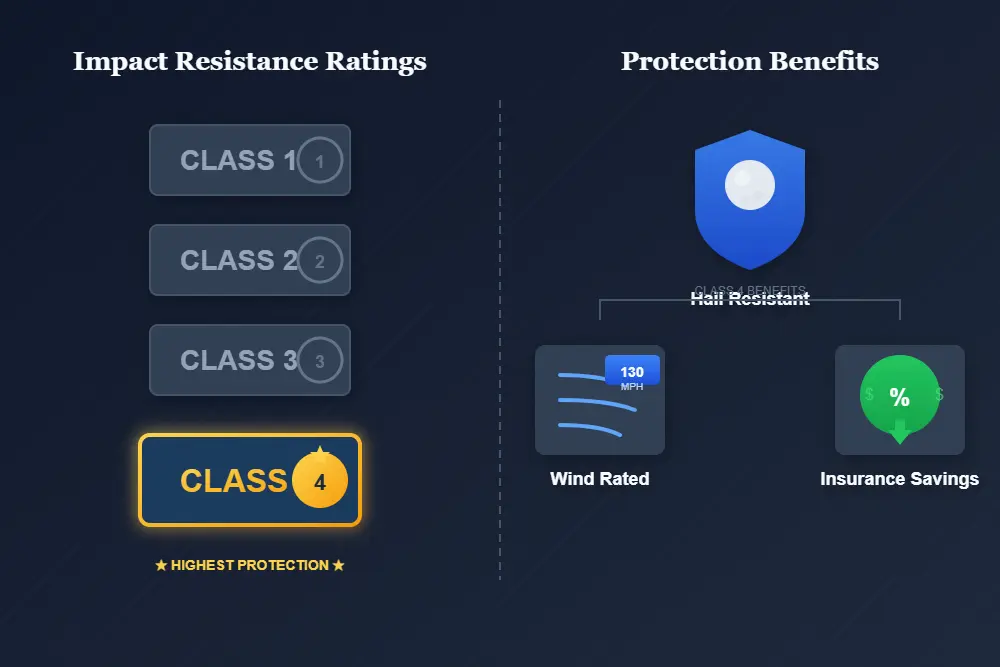
Impact resistance is measured by the UL 2218 test, developed by Underwriters Laboratories. The test is simple: drop a steel ball onto a shingle from a specific height and check for cracks on the back surface. If the shingle survives without fracturing, it passes. The size of the ball and the height of the drop determine the rating.
Here’s how the classes break down:
| Class | Steel Ball Diameter | Drop Height | Simulates Hail Size |
|---|---|---|---|
| Class 1 | 1.25 inches | 12 feet | Quarter-sized |
| Class 2 | 1.50 inches | 15 feet | Half-dollar-sized |
| Class 3 | 1.75 inches | 17 feet | Golf ball-sized |
| Class 4 | 2.00 inches | 20 feet | Baseball-sized |
Class 4 is the highest rating available. A Class 4 shingle has survived a 2-inch steel ball dropped from 20 feet—twice, in roughly the same spot—without cracking through. That’s the standard that matters for serious hail protection.
The test is conducted under controlled laboratory conditions. It doesn’t account for weathering, age, or installation variables. Real-world performance depends on more than just the rating. But Class 4 is the benchmark. If a shingle carries that rating, it’s been proven to handle significant impact.
Why Impact Resistance Matters in Michigan
Michigan isn’t in the heart of hail country—that distinction belongs to Texas, Colorado, and the Great Plains. But we’re not immune. Jackson County has recorded multiple damaging hailstorms, including events with hailstones exceeding two inches in diameter. Golf ball-sized hail is not unusual during severe summer thunderstorms.
The damage from a single hailstorm can be significant. Standard asphalt shingles crack and lose granules when struck by large hail. That damage might not be visible from the ground, but it compromises the shingle’s ability to shed water and resist UV degradation. The roof that looked fine after the storm starts failing months later.
For homeowners who’ve already been through one hail claim, the pattern is frustrating. The insurance covers the replacement, but you’re paying the deductible again. You’re dealing with contractors again. You’re losing time and peace of mind again.
Impact resistant shingles break that cycle. A Class 4 shingle that survives a hailstorm doesn’t need to be replaced. The claim doesn’t get filed. The deductible doesn’t get paid. The roof stays on and keeps working.
That’s the practical case for impact resistance in this part of Michigan. Not because we’re in tornado alley—because we get enough hail to make the investment worthwhile.
Wind Resistance Ratings — The Other Number That Matters
Impact resistance protects against hail. Wind resistance protects against blow-off. Both matter in Michigan, where summer storms bring both.
Wind resistance is tested separately from impact resistance. The relevant standards are ASTM D3161 (Class F) and ASTM D7158 (Class H). Class H is the higher rating, indicating the shingle can withstand sustained winds of 150 mph without lifting or tearing off.
Most premium impact resistant shingles carry both ratings—Class 4 impact and Class H wind. This combination means the shingle can handle hail hitting the surface and wind trying to peel it off. For Michigan homeowners, that’s the complete package.
Wind resistance depends heavily on proper installation. The shingle’s sealant strip must bond fully to the shingle below. Nails must be placed in the correct zone. If installation is sloppy, even a Class H shingle can blow off in a moderate storm. The rating reflects what the shingle can do when installed correctly.
When you’re comparing products, look for both numbers. A shingle with Class 4 impact and 150 mph wind resistance is built for severe weather. One or the other leaves a gap.
Atlas StormMaster Shake — What It Offers
We install Atlas StormMaster Shake shingles, so it’s worth explaining what makes them different from the general category of impact resistant shingles.
StormMaster Shake uses Core4 polymer modified technology—a proprietary blend that gives the shingle its flexibility and impact resistance. The shingle carries a UL 2218 Class 4 impact rating and is warranted against winds up to 150 mph. That’s the complete protection profile: hail and wind.
The construction includes a wider format (HP42 technology) that provides more coverage per shingle. This reduces the number of nails required, speeds up installation, and creates a more substantial architectural look on the roof. The aesthetic mimics wood shake without the maintenance and fire concerns that come with actual wood.
StormMaster Shake also includes 3M Scotchgard Protector, which prevents the black streaking caused by algae growth. Algae is a cosmetic issue, not a structural one, but it makes roofs look old before their time. The Scotchgard treatment keeps the roof looking clean for years.
There’s also 3M Smog-Reducing technology built into the granules—a feature that helps break down airborne pollutants. It’s a secondary benefit, not a primary reason to choose the product, but it’s there.
We’re not the only company that installs impact resistant shingles. Other manufacturers—Owens Corning, GAF, CertainTeed, Malarkey—make Class 4 products with similar performance characteristics. What matters is that you’re getting a Class 4 rated product from a manufacturer who stands behind it, installed by a contractor who knows how to do it right.
Insurance Discounts for Impact Resistant Roofs
Here’s where the math gets interesting. Many insurance companies offer premium discounts for homes with Class 4 impact resistant shingles. Michigan is one of the states where these discounts are available.
The discount varies by insurer and policy. Typical ranges are 5% to 35% off your annual premium, with most homeowners seeing something in the 10% to 20% range. For a policy that costs $2,000 per year, that’s $200 to $400 in annual savings. Over a 25-year roof lifespan, those savings add up.
To qualify, you’ll need documentation. Most insurers require a certification form completed by your roofing contractor confirming the product installed, its UL 2218 rating, and the installation date. Some require photos. The paperwork is straightforward—any reputable contractor will provide it.
There’s a catch: discounts typically aren’t available for overlay installations. If your new roof is installed over an existing layer of shingles rather than on fresh decking, some insurers won’t apply the discount. If you’re considering whether to overlay or tear off, the insurance implications are worth factoring into the decision.
Contact your insurance company before installation, not after. Confirm that the product you’re planning to install qualifies for a discount, understand what documentation they need, and get the discount amount in writing. Different insurers have different lists of qualifying products—make sure yours is on it.
Cost Premium vs Long-Term Value
Impact resistant shingles cost more than standard architectural shingles. The premium varies by product and market, but expect to pay 20% to 40% more for materials. On a typical Jackson County home, that might mean an additional $1,500 to $3,000 on the total project.
Is it worth it? That depends on how you calculate value.
Start with the insurance discount. If you’re saving $300 per year on premiums, that’s $7,500 over a 25-year roof lifespan. The upfront premium pays for itself in insurance savings alone—before you account for anything else.
Then consider avoided claims. Every hail damage claim you don’t file is a deductible you don’t pay. If your deductible is $1,500 and impact resistant shingles prevent one claim over the life of the roof, you’ve recovered half your investment right there. Prevent two claims and you’re ahead.
There’s also the question of lifespan. Impact resistant shingles are built tougher than standard shingles. They resist granule loss, cracking, and weathering better. Many outlast their warranties. A roof that lasts 30 years instead of 22 is eight years of not buying another roof.
Finally, consider the intangible: peace of mind during storm season. When the hail starts falling and your neighbors are wondering if their roofs survived, you’re not wondering. You know.
The price difference isn’t trivial. But when you add up insurance savings, avoided claims, extended lifespan, and reduced stress, impact resistant shingles often deliver more value than their cost. To understand how this fits into the full picture of roof replacement pricing, you’ll want to compare the total investment—not just the material upgrade.
Frequently Asked Questions
Are impact resistant shingles worth it in Michigan?
For many homeowners, yes. Jackson County sees enough hail to make the investment worthwhile, and insurance discounts can offset much of the upfront cost. If you’ve already filed a hail damage claim in the past, impact resistant shingles are especially worth considering—they can break the cycle of damage and replacement.
What’s the difference between Class 3 and Class 4 shingles?
Class 3 shingles withstand a 1.75-inch steel ball dropped from 17 feet. Class 4 shingles withstand a 2-inch steel ball dropped from 20 feet. Both offer impact resistance, but Class 4 is the higher standard and typically required for insurance discounts. If you’re upgrading for hail protection, Class 4 is the rating to look for.
Do all insurance companies offer discounts for impact resistant roofs?
No. Discount availability varies by insurer and state. Michigan is among the states where discounts are commonly available, but the percentage and qualifying products differ by company. Contact your insurer before installation to confirm you’ll qualify and understand the documentation requirements.
Can I get impact resistant shingles in different colors and styles?
Yes. Impact resistant shingles come in a full range of colors and profiles, including architectural styles that mimic wood shake. You’re not limited to a single look. Most manufacturers offer 8 to 12 color options in their Class 4 product lines.
How long do impact resistant shingles last?
Most carry warranties of 25 to 50 years, depending on the product and manufacturer. Real-world lifespan depends on installation quality, ventilation, and local conditions. Because they’re built tougher, impact resistant shingles often outlast standard shingles by several years—some homeowners report 30+ years of service from premium products.