
Most people believe roofs fail without warning. One day everything’s fine, the next day there’s water dripping through the ceiling. Bad luck. Bad timing. Nothing you could’ve done.
That’s not how it works.
Roofs almost always signal trouble before they fail. A shingle curls. Flashing pulls away from a chimney. Granules pile up in the gutter. The warnings are there—they’re just easy to miss if you don’t know what you’re looking for. By the time water’s coming through the ceiling, what started as a $300 repair has become a $3,000 problem.
We’ve been repairing roofs in Jackson County for over 30 years—more than 5,000 of them. We’ve seen every version of every common roof problem, and we’ve seen what happens when they get caught early versus what happens when they don’t. The difference isn’t luck. It’s knowing what to look for. This post is the field guide.
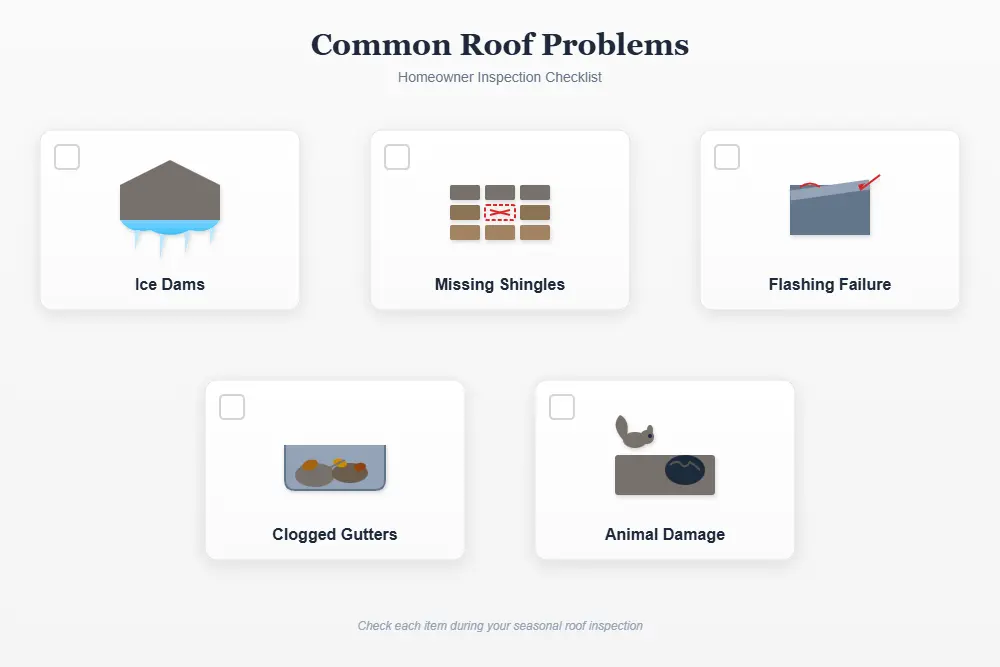
Missing, Cracked, or Curling Shingles
Shingles are the first line of defense. When they fail, everything underneath them is exposed.
Missing shingles are the obvious ones. You’ll see bare patches of underlayment or decking where a shingle used to be. High winds are the usual culprit, but age and improper installation cause shingles to lift and blow off too. One missing shingle might not seem urgent—until the next rain drives water straight into the gap and down into your attic.
Cracked shingles are harder to spot from the ground. They happen when the asphalt in the shingle dries out over time, losing flexibility. Temperature swings accelerate it. A shingle that freezes and thaws dozens of times per season will crack faster than one in a stable climate. Jackson County gets both extremes, sometimes in the same week.
Curling shows up in two forms. Cupping is when the edges turn upward while the middle stays flat. Clawing is the opposite—the edges stay down but the middle humps up. Both indicate the shingle has reached the end of its useful life. Curled shingles can’t seal properly, and they’re far more likely to blow off or crack.
Here’s what to check: stand at the street and scan each section of roof. Look for color variations that suggest missing shingles. Look for edges that don’t lie flat. If you can see the problem from the driveway, it’s already significant enough to address. If you’re unsure, binoculars help—or call someone who climbs roofs for a living.
Flashing Failures Around Chimneys, Vents, and Skylights
Flashing is the metal (usually aluminum or galvanized steel) that seals the joints where the roof meets something else—a chimney, a vent pipe, a skylight, a wall. It’s one of the most failure-prone parts of any roof, and when it fails, you’re looking at a roof leak that needs professional repair.
Around chimneys, flashing typically runs in two layers: step flashing along the sides and counter-flashing embedded in the mortar. If the mortar cracks, the counter-flashing pulls away. If the step flashing wasn’t installed correctly—or if it’s corroded after years of exposure—water runs behind it instead of over it. You won’t see the leak at the chimney. You’ll see it in a ceiling stain ten feet away.
Vent pipe flashings are simpler but fail just as often. Most have a rubber boot that seals around the pipe. Rubber degrades in UV light. After 10 to 15 years, those boots crack and split. Once that seal breaks, every rain sends water straight down the pipe and into the house.
Skylight flashing is a two-part problem. The flashing around the frame can fail, but so can the seal between the glass and the frame itself. If you see water around a skylight, don’t assume it’s the roof—it might be the skylight. Either way, it needs attention.
Flashing failures are sneaky. The leak often shows up far from the source because water travels along rafters and sheathing before it drips through. If you have stains on a ceiling or wall and you can’t find an obvious entry point, flashing is usually the answer.
Gutter-Related Roof Damage
Gutters aren’t technically part of the roof, but when they fail, the roof pays for it.
Clogged gutters are the most common issue. Leaves, twigs, and granules from aging shingles pile up. Water backs up behind the clog. In warm weather, that backed-up water spills over the edge, saturating the fascia board and potentially working its way under the drip edge. In cold weather, it’s worse—the water freezes, creating ice dams that force melt underneath the shingles.
Ice dams deserve their own explanation. When heat escapes through the roof (usually from poor attic insulation or ventilation problems that lead to mold and moisture damage), it melts snow on the upper part of the roof. That melt runs down toward the eaves, where the roof is colder because it overhangs the heated house. The water refreezes, forming a ridge of ice. More melt backs up behind the dam, pooling on the roof surface. That pooled water finds its way under shingles and into the house.
Ice dams cause more emergency calls in Jackson County winters than almost anything else.
Fascia rot is the slow-motion version of the same problem. When gutters overflow repeatedly, the wooden fascia board behind them stays wet. Wood that stays wet eventually rots. Once the fascia goes soft, the gutter pulls away from the house, the problem accelerates, and now you’ve got a structural repair on top of a roofing repair.
Cleaning gutters twice a year—once after the leaves fall and once in spring—prevents most of this. It’s not exciting advice. It’s just the truth.
Tree Damage — Branches, Debris, and Moss
Trees are good for shade and curb appeal. They’re not always good for roofs.
The obvious threat is impact damage. A falling branch can crack shingles, dent flashing, and punch through decking. But you don’t need a major storm to cause problems. Branches that hang over the roof scrape against shingles every time the wind blows. Over months and years, that abrasion wears through the protective granule layer and exposes the asphalt underneath. A roof with a bald spot ages faster.
Leaf debris is subtler. Leaves pile up in valleys, around chimneys, and behind dormers. They trap moisture against the roof surface. Wet leaves become a mat that holds water long after the rain stops. That prolonged moisture accelerates shingle deterioration and creates a hospitable environment for moss and algae.
Moss isn’t just cosmetic. Moss roots work their way under shingle edges, lifting them and breaking the seal that keeps water out. A mossy roof looks charming in photographs and leaks in reality. Shade-heavy roofs—the ones under large trees—grow moss faster because the roof stays damp longer. Sunlight is a natural moss inhibitor.
The fix is maintenance. Trim branches so they’re at least six feet from the roof surface. Clear debris from valleys and gutters. If moss has already established, it can be treated—but prevention is easier than remediation.
Animal Damage — Squirrels, Raccoons, and Birds
Animals see your roof as real estate. They’re looking for shelter, warmth, and a place to raise their young. Your attic checks every box.
Squirrels are the most common culprits in Jackson County. They gnaw through fascia boards, soffits, and even shingles to access the attic. A determined squirrel can chew through wood surprisingly fast. Once inside, they build nests, leave droppings, and chew on wiring—which is a fire hazard in addition to a roofing problem.
Raccoons are stronger and cause bigger damage. They can tear off soffits and rip through rotted wood with their hands. If you hear heavy footsteps in your attic at night, it’s probably not squirrels.
Birds cause damage in two ways. Woodpeckers drill holes in fascia and siding, looking for insects or creating nesting cavities. Other birds nest in vents, clogging them with debris and creating moisture problems. A dryer vent stuffed with bird nesting material is a fire hazard. A bathroom vent blocked by a nest can’t exhaust humidity, which contributes to attic moisture problems.
Signs of animal damage include visible holes in soffits or fascia, droppings near roof edges, and scratching or movement sounds in the attic. If you see an entry point, assume something has used it. Get the animal out first (or hire someone who handles wildlife removal), then repair the entry point properly—not with a quick patch that another squirrel will chew through next month.
Improper Previous Repairs That Create New Problems
This one hurts to write, but we see it constantly: a repair done wrong becomes the source of the next problem.
The most common example is layered shingles. Someone had a worn-out roof and, instead of tearing it off and starting fresh, they nailed new shingles over the old ones. It’s cheaper upfront. It’s also heavier, doesn’t allow proper inspection of the decking, and creates an uneven surface where water can pool. In Michigan, where code allows up to two layers, plenty of roofs have them. That doesn’t mean it was the right call.
Mismatched materials cause failures too. We’ve seen repairs where someone used roofing cement as a primary sealant instead of proper flashing. Roofing cement is a patch material, not a system. It cracks. It separates. It buys time, maybe, but it doesn’t solve problems. Five years later, the homeowner has a leak in the same spot—plus the added mess of removing hardened cement before doing the job right.
“If a repair looks like it was done in a hurry, it probably was. And hurried repairs rarely last.”
Improper nailing is invisible but damaging. Shingles installed with too few nails, or nails in the wrong position, won’t hold in high winds. Overdriven nails puncture the shingle mat without gripping the decking properly. Underdriven nails sit proud and prevent the next shingle layer from sealing flat.
If you’ve had roof work done in the past and you’re seeing new problems in the same area, don’t assume the roof is just old. Sometimes the roof is fine—it’s the repair that failed.
That’s the field guide—the warnings your roof sends before things get expensive. Roofs don’t fail without warning. Now you know what to look for.
Frequently Asked Questions
How often should I actually inspect my roof?
Twice a year—once in spring and once in fall—plus after any major storm. You don’t need to climb up there. A good pair of binoculars and a walk around the house will catch most visible problems. If you see anything that looks off, call a professional for a closer inspection.
Can I fix small roof problems myself?
Some, but not most. Replacing a single missing shingle is within reach for a handy homeowner with proper safety equipment. Anything involving flashing, valleys, or structural repairs should be left to a professional. The risk isn’t just falling—it’s making the problem worse with an improper fix.
What’s the most expensive common roof problem to repair?
Ice dam damage, because it rarely stops at the roof. By the time water backs up under shingles, it’s often soaked the decking, insulation, and drywall below. You’re not just fixing the roof—you’re fixing everything the water touched on its way down.
How do I know if a roof problem is urgent or can wait?
Anything actively leaking is urgent. Missing shingles with exposed underlayment need attention before the next rain. Curling shingles, minor flashing gaps, and surface moss can usually wait for a scheduled repair—but don’t wait more than a few months. Small problems don’t fix themselves, and Michigan weather doesn’t give long grace periods.
Why do some roof problems keep coming back after repairs?
Usually because the original repair addressed the symptom, not the cause. A patched leak will return if the flashing underneath is still failing. Re-secured shingles will blow off again if the decking is too rotted to hold nails. Good repairs fix the system, not just the surface.
If you’ve spotted something on this list—or if you just want someone to take a closer look—that’s what we’re here for. No pressure, no sales pitch. Just 30+ years of honest answers about what your roof needs.