
You hear it before you see it. A drip somewhere in the house that wasn’t there yesterday. Maybe it’s hitting the attic floor. Maybe it’s already working its way through the ceiling. Either way, the clock just started.
A roof leak doesn’t wait. It doesn’t politely pause while you research contractors or check your calendar. Water is moving through your roof assembly right now, and every hour it continues is another hour of damage to insulation, drywall, framing, and anything else in its path.
This guide is for Jackson County homeowners who are dealing with a leak—or who want to know what to do when one happens. We’ll cover what causes leaks, where they typically start, what you can do before a contractor arrives, and how to tell whether you’re looking at a repair or something bigger. The goal is to get you from “there’s water coming in” to “I know what’s happening and what to do next” as fast as possible.
What Causes Roof Leaks
Leaks don’t happen randomly. They happen because something failed—something that was keeping water out stopped doing its job. Understanding the cause helps you understand the fix.
Age and wear. Shingles deteriorate over time. The asphalt dries out, granules shed, edges curl, and sealant strips fail. An aging roof develops weak points everywhere. A leak on a 20-year-old roof might not be one problem—it might be the first visible symptom of a roof that’s worn out everywhere.
Storm damage. High winds lift shingles, break seals, and tear off entire sections. Hail cracks shingles and dislodges granules. Fallen branches puncture the roof surface. Storm damage creates immediate penetration points that didn’t exist the day before.
Flashing failure. Flashing is the material that seals joints and transitions—around chimneys, vents, skylights, and where roof planes meet walls. When flashing corrodes, cracks, or pulls away from the surface it’s supposed to seal, water gets behind it. Flashing problems are one of the most common leak sources.
Clogged gutters and ice dams. When gutters clog, water backs up under the shingles at the eaves. In winter, ice dams form when snow melts, runs down to the cold eaves, and refreezes. The ice creates a dam that traps water behind it, and that water has nowhere to go but under the shingles and into your house.
Failed pipe boots and vent seals. Every pipe that penetrates your roof—plumbing vents, exhaust vents—has a rubber boot or seal around it. These rubber components degrade in UV light and temperature extremes. After 10-15 years, they crack and shrink, leaving gaps around the pipe. Water follows the pipe right into your attic.
Improper installation. Sometimes leaks trace back to mistakes made during the original installation. Nails in the wrong position, inadequate underlayment, skipped flashing, or shingles installed over debris—these problems can take years to show up, but they were built in from day one.
How Water Finds Its Way In
Here’s what makes leaks tricky: water doesn’t drip straight down from where it enters. It travels.
Water follows the path of least resistance. It runs along rafters, follows the underside of sheathing, pools on vapor barriers, and wicks through insulation. The drip you see in your bedroom might have entered the roof 10 or 15 feet away, traveled horizontally through the attic, and finally dropped through the first gap it found in the ceiling.
This is why finding the entry point isn’t as simple as looking directly above the stain. It’s also why small drips can indicate big problems—the water is pooling somewhere before it drips, and everything in that pooling zone is getting wet even if you can’t see it.
In an attic, water often runs along the top of insulation or follows electrical wires and conduits before finding a way down. It can travel 20 feet horizontally before showing up as a ceiling stain. That stain is the last stop, not the source.
When you’re trying to locate a leak, start from where the water appears and work backward. Look for staining, moisture, or daylight in the attic above the drip. Follow any visible water trails toward the roof deck. The entry point is usually uphill from where the damage shows—sometimes much farther uphill than you’d expect.
Common Leak Locations
Leaks concentrate in predictable places. If you know where roofs typically fail, you know where to look first.
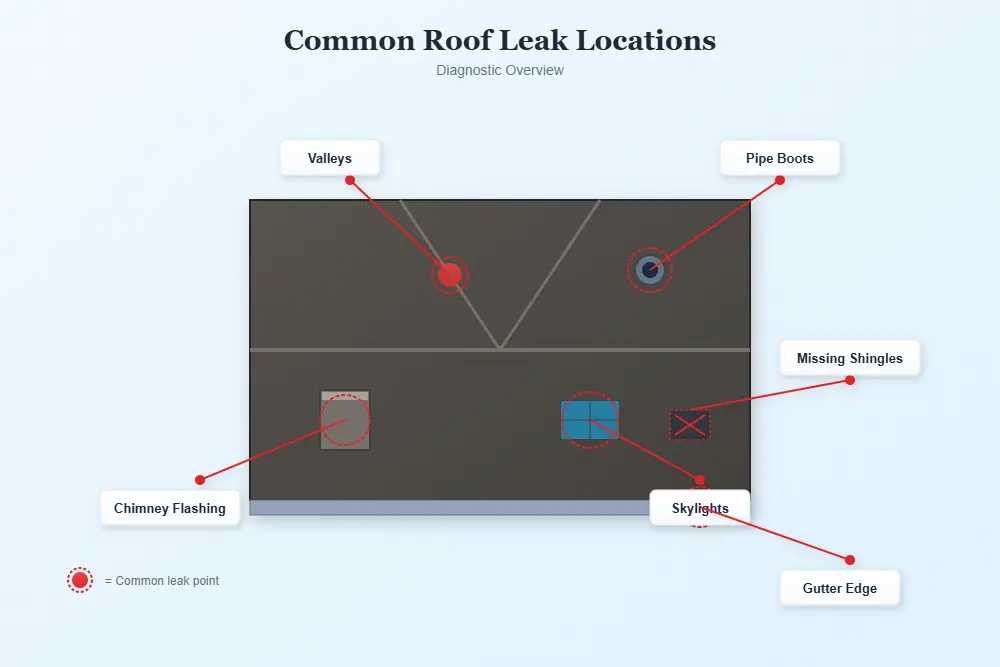
Valleys. Valleys are where two roof planes meet and slope downward together. They channel a lot of water, which means they handle a lot of stress. If the valley flashing is damaged, improperly overlapped, or missing, water can get underneath and into the roof structure. Valleys are high-priority inspection points after any major storm.
Chimneys. Chimneys have multiple failure points: the flashing where the chimney meets the roof, the counter-flashing embedded in the mortar joints, the cricket (a small peaked structure behind the chimney that diverts water), and the cap at the top. Any of these can fail independently. Chimney leaks are common and often misdiagnosed.
Skylights. Skylights are holes in your roof, sealed with flashing and relying on proper installation to stay watertight. The seals around skylight frames degrade over time. The flashing can pull away from the curb. Condensation can form on the inside and drip down, mimicking a leak. Skylights require more maintenance attention than the surrounding roof.
Plumbing vents. Every house has pipes poking through the roof for plumbing ventilation. Each one has a rubber boot around the base. Those boots crack and fail. When they do, water runs down the pipe and into the attic. It’s one of the easiest leaks to fix—and one of the most overlooked.
Roof-to-wall transitions. Where a lower roof meets a vertical wall—a common configuration with additions, dormers, and split-levels—step flashing and kick-out flashing direct water away from the wall. If these fail, water can run down inside the wall cavity, causing damage you don’t see until it’s severe.
Eaves and rake edges. The edges of your roof are where water exits—or where it backs up when gutters fail or ice dams form. Drip edge that’s missing or improperly installed lets water wick back under the shingles. Problems at the edge often show up as staining on fascia boards or soffit.
What to Do When You Discover a Leak
You’ve found water coming in. The contractor isn’t here yet. What do you do right now?
Contain the water. Put a bucket or container under the drip. If water is pooling on the ceiling and bulging the drywall, poke a small hole in the center of the bulge with a screwdriver and let it drain into a bucket. This sounds counterintuitive, but it prevents the water from spreading across the ceiling and collapsing a larger section.
Move what you can. Get furniture, electronics, and valuables out from under the leak path. Water travels. What’s dry now might not be dry in an hour. If you can’t move something, cover it with plastic sheeting or garbage bags.
Document the damage. Take photos and video of the leak, the water damage, and anything that’s been affected. Date-stamp everything. This documentation matters for insurance claims and contractor assessments. Capture the scope before you start cleanup.
If it’s safe, check the attic. If you can access your attic, a quick look might tell you where the water is entering. Use a flashlight. Look for wet insulation, staining on the underside of the roof deck, or daylight coming through. Don’t walk on attic joists if you’re not comfortable up there—falling through a ceiling makes a bad day worse.
Temporary exterior protection. If the leak is severe and you can safely access the roof, a tarp weighted down with boards or sandbags can reduce water intrusion until a permanent repair happens. But roofs are dangerous, especially when wet. If you’re not confident, don’t go up. A tarp isn’t worth a fall.
Call for professional roof repair. Once you’ve contained the immediate damage, get a contractor on the phone. Describe what you’re seeing—where the water is coming in, how much, how long it’s been happening. A good contractor will prioritize active leaks and get someone out fast.
Active Leak vs Old Water Damage
Not every stain on your ceiling means water is actively coming in right now. Some damage is old. Knowing the difference helps you understand the urgency.
Active leaks show up as wet spots, dripping water, or stains that are getting larger while you watch. The ceiling or wall feels damp to the touch. In severe cases, drywall sags or bubbles with trapped water. If rain is falling and the stain is growing, the leak is active.
Old water damage looks like dried rings, often brown or yellow, with distinct edges. The surface is dry. The stain doesn’t change when it rains. This indicates a leak that happened in the past—maybe during a specific storm, maybe from an ice dam last winter—but isn’t happening now.
Old damage doesn’t mean the problem is fixed. It means the leak conditions aren’t currently present. A leak that happens only during wind-driven rain might not show activity during a gentle shower. A leak from ice dams only appears in winter. The source might still be there, waiting for the right conditions.
When you call a contractor, describe what you see: “There’s a brown ring on the ceiling that’s been there for months, dry to the touch” is different from “There’s water dripping through the ceiling right now.” Both need attention, but the active leak needs it today.
Why Leaks Get Worse If You Wait
A small leak doesn’t stay small. Water damage is cumulative and accelerating.
The first thing water destroys is insulation. Wet insulation loses its R-value—it stops insulating. It also holds moisture against the roof deck and ceiling, creating conditions for rot and mold. Once insulation is saturated, it doesn’t dry out on its own. It has to be replaced.
Next comes the wood. Roof decking, rafters, ceiling joists, and wall framing absorb moisture. Wood that stays wet develops rot. Rot spreads. What starts as a soft spot becomes structural failure. A $400 repair becomes a $4,000 repair when you’re replacing rotted framing.
Then there’s mold. Mold needs moisture, warmth, and organic material to grow. A leaky attic provides all three. Once mold establishes, it spreads through the attic space and can work its way into living areas. Mold remediation is expensive and disruptive—far more than fixing the leak that caused it.
Ceiling and wall damage compounds too. Drywall that gets wet once might dry and show only a stain. Drywall that gets wet repeatedly crumbles. Paint peels. Texture fails. What could have been a patch-and-paint job becomes a full ceiling replacement.
The message is simple: every day you wait is another day of damage. The cost of the repair goes up. The scope of the repair goes up. The hassle of the repair goes up. Small problems become big problems because someone decided to “keep an eye on it” instead of fixing it.
Roof Leak Repair vs Replacement — When Each Makes Sense
Not every leak is a repair job. Some leaks are telling you the roof is done.
Repair makes sense when:
The leak is isolated. One failed pipe boot, one section of damaged flashing, one missing shingle from a storm—these are point failures on an otherwise sound roof. Fix the point, and the roof keeps working.
The roof is relatively young. A leak on a 7-year-old roof is probably a defect or damage, not age-related failure. Repair makes sense because the rest of the roof has years of life left.
The damage is localized. If the leak affected a small area and didn’t compromise structural elements, repair the roof and repair the interior damage. Done.
Replacement makes more sense when:
The leak is one of several problems. If you’re seeing curling shingles, granule loss in the gutters, and leaks in multiple locations, the roof is failing systemically. Fixing one leak doesn’t fix the others waiting to happen.
The roof is near the end of its lifespan. A leak on a 22-year-old roof is a symptom of overall aging. You can patch it, but you’ll be patching again next year, and the year after. At some point, continuing to repair costs more than replacing.
The damage is extensive. If the leak has rotted decking, damaged framing, or created widespread mold, the repair scope is already large. Adding a new roof to that scope might be the smarter long-term investment.
There’s no bright line here. A good contractor will assess the roof’s overall condition, not just the leak, and give you an honest recommendation. If they say repair, repair. If they say replace, ask them to show you why—and get a second opinion if you’re not sure.
A leak is a signal. Sometimes it’s saying “fix this spot.” Sometimes it’s saying “this roof is done.” Learning to read that signal is how you make the right call.
Frequently Asked Questions
How fast should I act when I discover a roof leak?
Immediately. Contain the water, protect your belongings, and call a contractor the same day. Water damage compounds quickly—what’s a minor issue today becomes a major issue next week. Don’t “wait and see.” Act.
Can I fix a roof leak myself?
Minor temporary measures—tarps, buckets, moving belongings—yes. Permanent roof repairs, generally no. Roofs are dangerous to work on, and improper repairs can void warranties and create bigger problems. Get a professional involved for anything beyond immediate containment.
Why is the stain on my ceiling far from where the leak is entering?
Water travels. It runs along rafters, follows the underside of sheathing, and wicks through insulation before finding a gap to drip through. The stain is where the water ended up, not where it got in. The entry point might be 10-20 feet away, uphill along the roof.
Does homeowner’s insurance cover roof leak repair?
It depends on the cause. Sudden damage from storms or falling trees is usually covered. Gradual deterioration, neglected maintenance, and wear-and-tear are usually not. Check your policy and document the damage before cleanup. Your insurer will want to know when, how, and why the leak happened.
How do I know if my leak needs repair or if I need a new roof?
Consider the roof’s age, overall condition, and whether this is an isolated problem or part of a pattern. A single point failure on a younger roof is a repair. Multiple problems on an aging roof might mean replacement makes more sense. A qualified contractor can assess the full picture and give you an honest recommendation.