
Your roof is talking to you. The question is whether you’re listening.
Most homeowners don’t think about their roof until something forces them to—a leak in the bedroom ceiling, shingles scattered across the yard after a storm, or a home inspector’s report that kills a sale. By then, the conversation has shifted from maintenance to emergency. The signs were there earlier. They just went unnoticed.
This guide is about noticing. We’re going to walk through the signs you need a new roof—the visual cues, the interior warnings, the age-related realities—so you can catch problems while you still have options. Not every sign means immediate replacement. But every sign means something, and ignoring them doesn’t make the problem smaller. It makes the eventual bill bigger.
Here’s what to look for.
Curling, Cracking, or Missing Shingles
Start with what you can see from the ground. Walk to the curb, look up, and scan the roof surface. Healthy shingles lie flat. They overlap evenly. The color is relatively consistent across the roof plane.
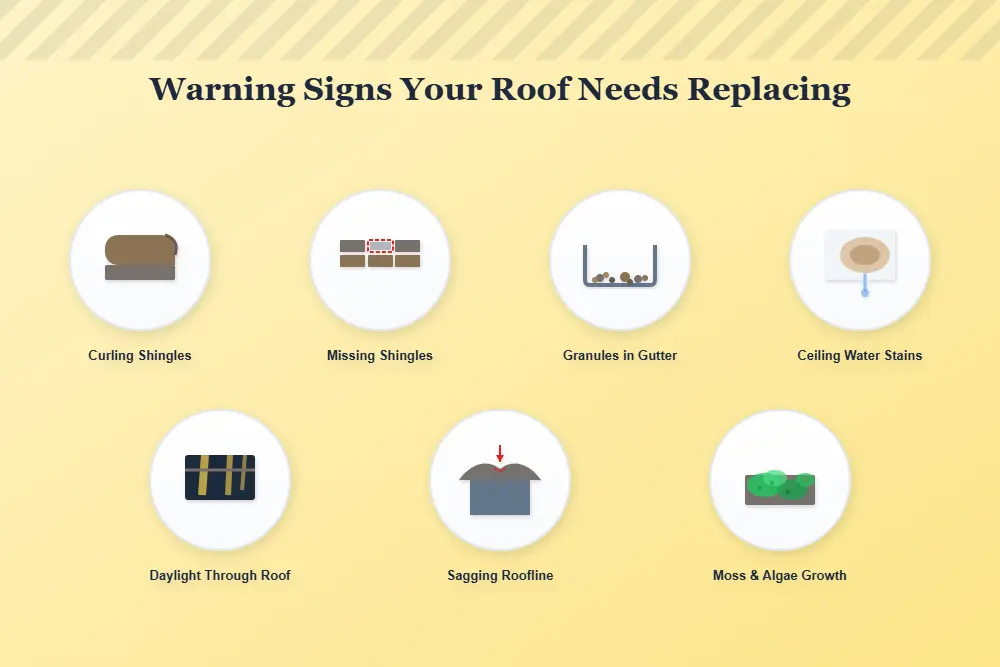
Curling shingles are shingles that have started to lift at the edges or cup in the middle. This happens when the asphalt dries out and loses flexibility. Once a shingle curls, it can’t seal properly against the shingle below it. Water gets underneath. Wind gets underneath. The shingle becomes a liability instead of a barrier.
Cracking is a similar story. You’ll see visible fractures running through the shingle surface—sometimes fine lines, sometimes deep splits. Cracked shingles are brittle shingles. They’ve lost the oils that kept them pliable, and they’re approaching failure. A cracked shingle can shed pieces in the next windstorm or simply stop shedding water the way it’s supposed to.
Missing shingles are the most obvious sign. If you can see bare spots where shingles used to be—exposed underlayment or even bare wood—the roof is already compromised. One missing shingle might be a fluke. Several missing shingles, especially in the same area, tell you the adhesive has failed and more will follow.
A few curled or cracked shingles on an otherwise sound roof might be addressable. A pattern of damage across multiple areas is a different conversation.
Granules in Your Gutters
Clean out your gutters this season? Look at what comes out. If you’re seeing a lot of coarse, sand-like granules—gray, black, or the color of your shingles—that’s not dirt. That’s your roof.
Asphalt shingles are coated with ceramic granules. Those granules do most of the work: they protect the asphalt from UV rays, they add fire resistance, and they give the shingle its color. When granules start shedding, the shingle loses its armor. The exposed asphalt deteriorates faster. The shingle’s lifespan shortens.
Some granule loss is normal, especially on a new roof in its first year. The manufacturing process leaves loose granules on the surface, and they wash off with the first few rains. That’s not a concern.
Heavy granule loss on an older roof is different. If your gutters fill with granules every time it rains, or if you’re seeing bare patches on the shingle surface where granules used to be, the roof is aging out. The shingles are past their functional peak. They’ll still shed water for a while, but they’re on borrowed time.
Check your downspout discharge areas too. Granules accumulate there. A pile of granules at the base of the downspout is the same warning sign—just in a different location.
Water Stains, Daylight, and Attic Moisture
The roof’s job is to keep water out. When it fails, the evidence shows up inside.
Water stains on ceilings are the classic warning sign. Brown rings, discoloration spreading from a point, paint bubbling or peeling—these mean water is getting through the roof assembly and reaching the interior. The stain you see on the ceiling isn’t necessarily directly below the leak. Water travels along rafters and sheathing before it drips, so the entry point might be several feet away from where the damage appears.
Go into your attic during daylight. Turn off any lights and let your eyes adjust. If you can see pinpoints of light coming through the roof boards, those are holes. They might be nail pops, they might be deteriorated areas, they might be damage you didn’t know existed. Either way, if light gets through, water gets through.
While you’re in the attic, look for moisture. Black staining on the underside of the sheathing is often mold or mildew—a sign that moisture is present and not drying out. Wet insulation, damp rafters, or visible condensation on surfaces all point to water intrusion. In Michigan, ice dams can push water into the attic even without an obvious roof hole, but persistent moisture regardless of cause means the roof system isn’t performing.
An attic should be dry. If yours isn’t, the roof is part of the problem.
Sagging Roof Deck or Roofline
This one is serious. A sagging roof is a structural issue, not just a surface issue.
Stand back from your house and look at the roofline—the ridge at the top, the edges along the eaves. It should be straight. If you see a visible dip, a bow, or a section that looks lower than the rest, the decking underneath has weakened. This usually means prolonged water damage has rotted the plywood or OSB sheathing. The structure that holds the shingles up is failing.
You might also notice a soft or spongy feel if you walk on the roof (though we don’t recommend walking on a roof unless you know what you’re doing). Areas that flex underfoot instead of feeling solid are areas where the decking has lost integrity.
Sagging doesn’t reverse itself. It gets worse. A sagging roofline means the roof needs replacement—and the decking underneath will need to be replaced too. This isn’t a “maybe” situation. This is a “how soon can we schedule it” situation.
Don’t wait on this one. Structural failure isn’t gradual. It’s gradual until it isn’t.
Moss, Algae, and Biological Growth
Green or black streaks on your roof aren’t just cosmetic. They’re telling you something about moisture retention.
Moss grows in damp, shaded conditions. If you have thick moss on your shingles—especially on north-facing slopes or under tree cover—it means the roof surface is staying wet long enough for moss to establish. Moss holds moisture against the shingle surface. Over time, that moisture works its way under the shingle edges, accelerating deterioration. Moss can also lift shingle edges as it grows, creating gaps where water enters.
Algae appears as dark streaks, usually black or dark green. It’s less physically damaging than moss, but it’s feeding on the limestone filler in your shingles. Algae growth tells you the roof is retaining moisture and that the shingle surface is becoming a habitat instead of a barrier.
Lichen—the crusty, pale patches that combine algae and fungus—is harder to remove and indicates long-term moisture conditions.
A little algae on an otherwise sound roof isn’t an emergency. Heavy moss growth or biological coverage across large areas is a sign the roof environment has changed. Trimming back trees, improving airflow, and cleaning the surface can help—but if the growth returns quickly, the roof may be too far gone to recover.
Deteriorating Flashing
Flashing is the metal (usually aluminum or galvanized steel) that seals the joints where your roof meets something else—chimneys, vents, skylights, dormers, walls. These are the most leak-prone areas on any roof, and flashing is what keeps water out of them.
Look at the flashing around your chimney, around any pipes or vents poking through the roof, around skylights if you have them. What you’re looking for: rust, cracks, lifted edges, missing sections, or sealant that has dried out and pulled away. Any of these conditions means water can get behind the flashing and into the roof assembly.
Flashing failure doesn’t always mean you need a new roof. Sometimes flashing can be repaired or replaced independently. But deteriorating flashing on an aging roof is a sign that the entire system is reaching the end of its service life. The flashing and shingles often age together—they were installed together, they’ve weathered the same conditions, and they’re failing together.
If your flashing is compromised and your shingles are showing other warning signs, the answer usually isn’t to patch the flashing and hope for the best. It’s to understand that the cost of a full replacement makes more sense than incremental repairs on a roof that’s aging out everywhere at once.
How Old Is Your Roof? One of the Clearest Signs You Need a New Roof
Age matters. Every roofing material has a lifespan, and knowing where your roof falls on that timeline helps you interpret the signs you’re seeing.
Standard three-tab asphalt shingles last 15 to 20 years under normal conditions. Architectural (dimensional) asphalt shingles last 20 to 30 years. Premium asphalt shingles with enhanced durability can push toward 30 to 40 years, though that depends heavily on installation quality, ventilation, and climate exposure.
Michigan winters are hard on roofs. The freeze-thaw cycles, ice dams, heavy snow loads, and UV exposure during summer all accelerate aging. A roof rated for 25 years in a moderate climate might only deliver 20 years here. That’s not a defect—it’s just the reality of where we live.
If your roof is approaching the end of its expected lifespan—or past it—the signs we’ve covered carry more weight. Curling shingles on a 10-year-old roof might be a manufacturing defect or an installation issue. Curling shingles on a 22-year-old roof are probably just age. The roof did its job. Now it’s done.
Don’t know how old your roof is? Check your records from when you bought the house—inspection reports often include roof age estimates. If you’ve owned the home since the roof was installed, you already know. If you’re not sure and can’t find records, a professional inspection can give you an estimate based on material condition and wear patterns.
How to Inspect Your Roof from the Ground
You don’t need to climb a ladder to spot most warning signs. A ground-level inspection with your eyes and a pair of binoculars gets you most of the way there.
Start from the street. Walk around your house and look at the roof from every angle. You’re looking for the visual signs we’ve covered: curling or missing shingles, sagging areas, moss or algae growth, damaged flashing around chimneys and vents. Binoculars help you see detail without getting on the roof.
Check your gutters. Pull out any debris and look at what’s in there. Granule accumulation tells you how fast the shingles are shedding their protective coating. Check downspout discharge points for granule piles.
Go inside. Check your attic for daylight, moisture, or staining. Check your ceilings for water spots or discoloration. These interior signs are just as important as what you see from outside.
Look after weather events. High winds, heavy snow, hail—these all stress roofs. A quick visual check after a significant weather event can catch new damage before it turns into a leak.
What you can’t assess from the ground: the actual condition of the shingle material up close, the integrity of the underlayment, the state of the decking, hidden flashing failures, or problems that only show up under close inspection. For that, you need a professional.
When should you call a pro? If you’re seeing multiple warning signs. If your roof is 15+ years old and you’ve never had it inspected. If you’ve had a significant weather event and want to confirm no damage occurred. If you’re trying to decide whether repair or replacement makes sense. A professional inspection costs less than a single repair job, and it gives you information you can’t get yourself.
Your roof is talking to you. Now you know how to listen. Some signs are small—a few granules in the gutter, a shingle or two that doesn’t look right. Others are urgent—sagging, daylight in the attic, water stains spreading on your ceiling. The difference between a manageable project and an emergency is whether you catch the signs early or ignore them until you can’t.
Frequently Asked Questions
How often should I inspect my roof?
Twice a year minimum—once in spring after winter weather, once in fall before it starts again. Also check after any major storm with high winds or hail. These quick visual inspections from the ground take ten minutes and can catch problems before they become expensive.
Can I walk on my roof to inspect it myself?
We don’t recommend it unless you have experience and proper safety equipment. Roofs are slippery, especially when wet or covered in granule debris. Falls are serious. Most warning signs are visible from the ground with binoculars, and a professional can safely inspect what you can’t see.
Does one missing shingle mean I need a new roof?
Not necessarily. A single missing shingle on an otherwise sound roof can often be replaced. But if multiple shingles are missing, or if the missing shingle reveals damaged underlayment or decking, that’s a bigger conversation. The age and overall condition of the roof determine whether one missing shingle is a small fix or a symptom of widespread failure.
What if my roof looks fine but it’s past its expected lifespan?
Have it inspected by a professional. Surface appearance doesn’t tell the whole story. A roof can look acceptable from the ground while the underlayment is deteriorating or the shingles have lost most of their granules. An inspection gives you actual data on remaining life expectancy so you can plan ahead instead of reacting to a failure.
Are dark streaks on my roof a sign I need replacement?
Not always. Dark streaks are usually algae, which is cosmetic and can be cleaned. However, heavy algae growth indicates moisture retention, and if it’s combined with other warning signs—granule loss, curling, age—it’s part of a larger pattern. Algae alone isn’t urgent. Algae plus multiple other issues might be.
Should I get a professional inspection before selling my house?
Yes. Buyers will have their own inspection done, and roof issues will come up. Knowing the roof’s condition in advance lets you address problems on your terms—either by making repairs, adjusting your price, or providing documentation that the roof is sound. Surprises during buyer inspections kill deals or cost you money in last-minute negotiations.