You’re standing in your driveway with a piece of paper in your hand. It’s an estimate. Somewhere between the line items and the total at the bottom, you stopped understanding what you were looking at. Square footage makes sense. Labor, sure. But what’s a “roofing square”? Why does pitch matter? And why does this number feel so different from the one your neighbor mentioned last summer?
This is where most Jackson County homeowners find themselves when they start asking about roof replacement cost. Not confused because they’re unintelligent—confused because the roofing industry has never bothered to explain itself in plain English.
That changes here.
We’re going to walk through exactly what determines the price of a new roof, what the realistic ranges look like in this part of Michigan, and how to read a contractor’s quote without needing a translator. By the end, you’ll know what you’re paying for—and why. That’s what we think you deserve before you sign anything.
What Determines Roof Replacement Cost
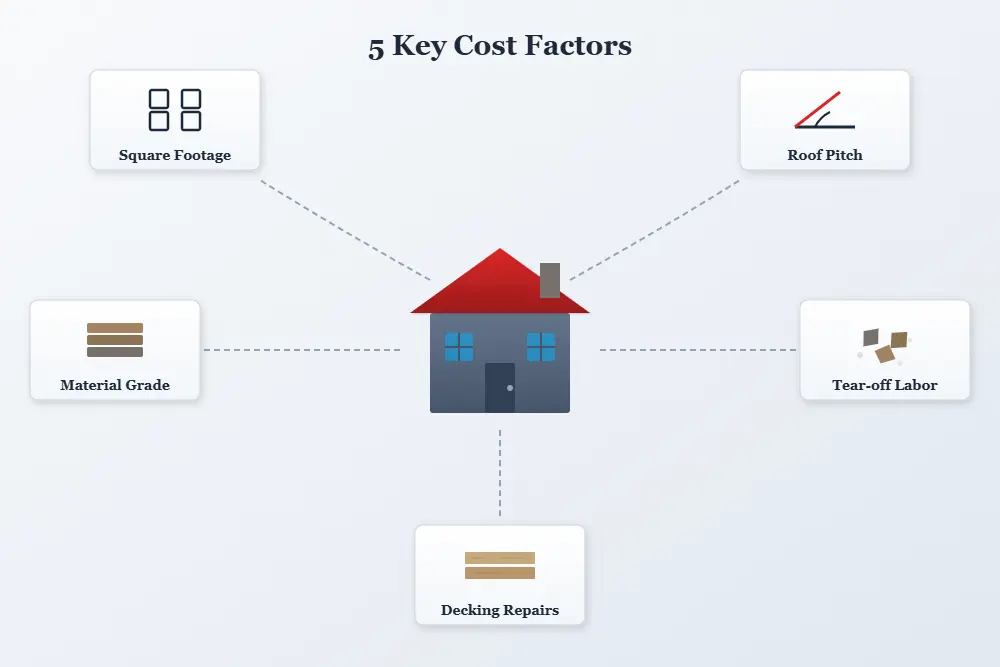
Four factors drive the price of every roof replacement. Understanding them means understanding why two houses on the same street can get estimates $8,000 apart.
Square footage is the starting point. Roofers measure in “squares”—one square equals 100 square feet of roof surface. A 2,000 square foot home doesn’t mean a 2,000 square foot roof. Roof area is typically 20% to 50% larger than your home’s floor plan because of pitch, overhangs, and design. A simple ranch with low slopes might only be 20% larger. A two-story with dormers and steep pitches could be 50% larger. More surface means more material and more labor.
Roof pitch is the angle of your roof—how steep it is. A low-slope roof is faster to work on and easier to navigate. Crews can move quickly and safely. Steep roofs require more caution, more safety equipment, and more time. That added labor shows up in the estimate. Most Jackson County homes have moderate pitches, but if your roof requires harnesses and extra staging, expect the labor portion to climb.
Material grade separates budget jobs from long-term investments. Basic three-tab shingles cost less upfront but wear faster. Architectural shingles—sometimes called dimensional or laminate shingles—cost more but last longer and look better. Premium shingles with enhanced wind and impact resistance sit at the top of the price range. The material you choose affects both the initial price and how long you’ll go before doing this again.
Tear-off versus overlay labor is the final variable. If you’re removing the old roof completely (tear-off), that’s additional labor and disposal cost. If local code allows and conditions permit, some roofs can be overlaid—new shingles installed directly over the existing layer. Overlays save money, but they’re not always the right call. We’ll touch on when they make sense in a moment.
These four factors—size, pitch, material, and tear-off scope—form the foundation of every estimate you’ll receive.
Roof Replacement Cost in Jackson County — Real Numbers
Let’s talk dollars. For a typical 2,000 square foot home in Jackson County using standard architectural asphalt shingles, most homeowners pay somewhere between $9,000 and $16,000 for a full roof replacement. That range accounts for differences in pitch, accessibility, and the scope of tear-off.
Here’s how material choice shifts the math:
✓ Asphalt shingles (architectural grade): $4.50 to $7.00 per square foot installed. The most common choice in Michigan. Good balance of price, durability, and weather resistance.
✓ Premium asphalt shingles: $6.00 to $9.00 per square foot installed. Enhanced wind ratings, longer warranties, better aesthetics. Worth considering if you’re planning to stay in the home long-term.
For most Jackson County homes, architectural asphalt shingles hit the sweet spot. They handle Michigan winters, they look good, and they don’t require a second mortgage. Premium shingles make sense if you’re staying long-term and want the extra durability — but standard architectural grade protects your home just fine.
Labor in this region typically runs $1.75 to $3.00 per square foot, depending on complexity. Steep roofs, limited access, and winter installations push that number higher. A straightforward ranch with easy driveway access and moderate pitch will land on the lower end. A multi-level home with tight lot lines and a 10/12 pitch will land on the higher end.
What Makes Quotes Go Higher
The base price is just the starting point. Several factors can push your estimate up—sometimes significantly.
Accessibility matters more than most homeowners expect. If crews can back a truck into your driveway and boom shingle bundles directly onto the roof, the job moves fast. If your home sits on a hill, has mature landscaping blocking access, or requires hand-carrying every bundle across the yard and up a ladder—that’s added time and labor. Access problems don’t change the material cost, but they change the labor cost considerably.
Multiple layers of old roofing increase tear-off labor and disposal fees. Michigan code allows up to two layers of shingles in most cases, so some homes have an old roof buried under the current one. Tearing off two layers takes longer, weighs more, and costs more to haul away. Every additional layer adds roughly $1.00 to $2.00 per square foot to the tear-off portion of your estimate.
Decking repairs are the variable you can’t see until the old roof comes off. Decking is the plywood or OSB sheathing underneath your shingles. If it’s rotted, soft, or water-damaged, it has to be replaced before new shingles go on. Decking replacement typically adds $500 to $3,000 depending on how much needs to go. Some contractors include a small allowance in the estimate; others price it as a change order once the damage is visible. Ask how this is handled before you sign.
Complex roof geometry—dormers, valleys, hips, skylights, chimneys—requires more cuts, more flashing, and more careful waterproofing. A simple gable roof is faster than a roof with six different planes and three penetrations. Complexity is priced into labor, so homes with intricate rooflines will always come in higher than simple rectangles.
Hidden Costs Most Homeowners Miss
The shingle price is the obvious number. These are the costs that catch people off guard.
Permits. Jackson County requires permits for roof replacements. Depending on your municipality, permit fees run $100 to $400. A legitimate contractor pulls permits—it’s not optional. If a contractor tells you they can skip the permit to save money, that’s a red flag, not a favor.
Dump fees. Old shingles have to go somewhere. Disposal costs depend on weight, and a full tear-off from a 2,000 square foot roof generates several tons of debris. Most contractors build this into the estimate, but some break it out separately. Either way, it’s part of the real cost.
Drip edge and flashing. Drip edge runs along the roof perimeter. Flashing seals around chimneys, vents, skylights, and valleys. These components protect the most vulnerable spots on your roof. If they’re not included in the estimate, they should be—skipping them creates leak points that will cost more to fix later than they cost to install now.
Ventilation upgrades. Proper attic ventilation extends shingle life and prevents moisture problems. If your current ventilation is inadequate—common in older Michigan homes—adding ridge vents or box vents may be recommended. This is a real improvement, not an upsell. Poor ventilation voids some manufacturer warranties and shortens roof life.
Ice and water shield. Michigan winters mean ice dams are a real concern. Ice and water shield is a self-adhesive membrane installed along eaves, valleys, and around penetrations. Code requires it in most applications here, but some contractors use more than the minimum for better protection. The extra coverage costs more but prevents the water intrusion that ice dams cause.
A good estimate itemizes these components. If you see a single line that says “roof replacement” with a number next to it, ask for the breakdown.
How to Read and Compare Contractor Quotes
You’ll probably get three estimates. Here’s how to actually compare them.
First, check that you’re comparing the same scope. Is one contractor pricing tear-off and another pricing overlay? Is one including new drip edge and another assuming the old edge is fine? Scope differences explain price differences. Make sure everyone is bidding the same job.
Second, look at material specifications. “Architectural shingles” is a category, not a product. What brand? What line? What warranty? A contractor quoting Owens Corning Duration at $12,000 and another quoting generic builder-grade at $9,500 aren’t offering the same thing. Know what you’re getting.
Third, verify what’s included versus what’s excluded. A low bid that excludes decking repairs, permits, and dump fees isn’t actually a low bid—it’s an incomplete bid. The real price becomes clear when the change orders start. Ask every contractor: what’s not included in this number?
Fourth, confirm licensing and insurance. Michigan requires roofing contractors to be licensed. Ask for the license number. Ask for proof of liability insurance and workers’ compensation coverage. If something goes wrong—injury, property damage—you need to know you’re protected. Contractors who hesitate here are contractors who should be crossed off your list.
Fifth, get it in writing. The estimate should include materials, labor, scope, timeline, payment terms, and warranty information. Verbal promises mean nothing when there’s a dispute. If it’s not on paper, it doesn’t exist.
The lowest number isn’t always the best value. The clearest, most complete estimate usually is.
What a New Roof Does for Your Home’s Value
A roof replacement isn’t just an expense. It’s an investment with measurable returns.
According to industry data, asphalt shingle roof replacements typically deliver a return on investment between 60% and 70% at resale. That means a $15,000 roof replacement could add $9,000 to $10,500 to your home’s selling price. In absolute terms, homeowners often see $12,000 to $15,000 added to their home’s resale value after a roof replacement.
But ROI percentages only tell part of the story.
A failing roof can stop a sale entirely. Lenders—especially FHA and VA—won’t approve mortgages on homes with roofs that don’t meet minimum condition standards. If buyers can’t get financing, your pool of potential offers shrinks to cash buyers looking for a discount. That discount is usually bigger than the cost of doing the roof yourself before listing.
Appraisers factor roof condition into their valuations. A new roof supports a higher appraisal. An aging roof with visible wear becomes a deduction. The difference can affect your home’s appraised value by thousands of dollars, which affects what buyers can borrow against it.
Even if you’re not selling, there’s value in protection. A sound roof prevents interior damage—water intrusion, mold, insulation failure—that costs far more to remediate than the roof would have cost to replace. The roof you ignore today becomes the ceiling repair, the drywall replacement, and the mold remediation bill tomorrow.
That’s the real ROI: avoiding the cascade of damage that follows a roof past its useful life.
Financing and Payment Options
Not everyone has $12,000 sitting in a checking account. That doesn’t mean you have to wait until the roof fails completely.
Most roofing contractors in Jackson County offer financing through third-party lenders. These programs typically work like personal loans—fixed monthly payments over a set term, with interest rates based on creditworthiness. Terms range from 12 months to 15 years depending on the amount and the lender.
Some financing programs offer promotional periods with deferred interest—no interest if paid in full within 12 or 18 months, for example. These can work well if you have the cash flow to pay aggressively but need to spread the initial hit. Read the terms carefully. If you don’t pay off the balance within the promotional window, interest often accrues retroactively from day one.
Home equity loans and HELOCs are another option if you have equity in your home. Interest rates are typically lower than personal loans, and the interest may be tax-deductible depending on your situation. The downside is that you’re using your home as collateral—default means risking your house.
Insurance claims cover some roof replacements when damage results from a covered event—hail, wind, fallen trees. If your roof damage started with a storm, contact your insurance company before signing a contract. An adjuster will assess the damage and determine coverage. Some contractors specialize in insurance work and will handle the claims process on your behalf.
Payment terms vary by contractor. Some require a deposit upfront with the balance due at completion. Others bill in stages—deposit, rough completion, final completion. Be wary of contractors who want full payment before work begins. Standard practice is deposit plus payment at completion, or staged payments tied to milestones.
The right financing option depends on your situation. What matters is that you understand the total cost—principal plus interest—before you commit.
If you’re staring at an estimate wondering whether the number makes sense, you’re asking the right question. Roof replacement cost isn’t mysterious—it’s just rarely explained. Now you know what drives the price, what the ranges look like here in Jackson County, and how to tell a good estimate from an incomplete one. That’s the foundation for making a decision you’ll feel good about.
Frequently Asked Questions
How long does a roof replacement take in Jackson County?
Most residential roof replacements take one to three days, depending on size and complexity. A straightforward ranch with good weather can be done in a single day. Larger homes, steep pitches, or unexpected decking repairs extend the timeline. We always give you a realistic window before we start.
Should I get multiple estimates before choosing a contractor?
Yes. Three estimates is a reasonable number. But don’t just compare the bottom-line price—compare scope, materials, and what’s included versus excluded. The lowest number often leaves out items that will show up as change orders later. A complete estimate from a licensed, insured contractor is worth more than a lowball number from someone cutting corners.
What’s the difference between a roofing square and a square foot?
One roofing square equals 100 square feet. Contractors use squares because materials are packaged and priced that way. If your roof is 2,000 square feet, that’s 20 squares. When comparing quotes, make sure you know whether the contractor is pricing per square or per square foot—the numbers look very different.
Will my homeowner’s insurance cover a roof replacement?
It depends on the cause. Insurance typically covers damage from sudden events—storms, hail, fallen trees. It does not cover wear and tear, age-related deterioration, or deferred maintenance. If your roof was damaged in a storm, file a claim and have an adjuster assess the damage before signing a contract. If the damage is from age, insurance won’t help.
How do I know if my roof needs replacement or just repairs?
Age is the first indicator—most asphalt roofs last 20 to 30 years. Visible signs include missing or curling shingles, granules in your gutters, sagging sections, and interior water stains. A professional inspection can tell you where your roof stands. Minor damage on a newer roof often makes sense to repair. Widespread issues on an aging roof usually mean replacement is the better investment.