
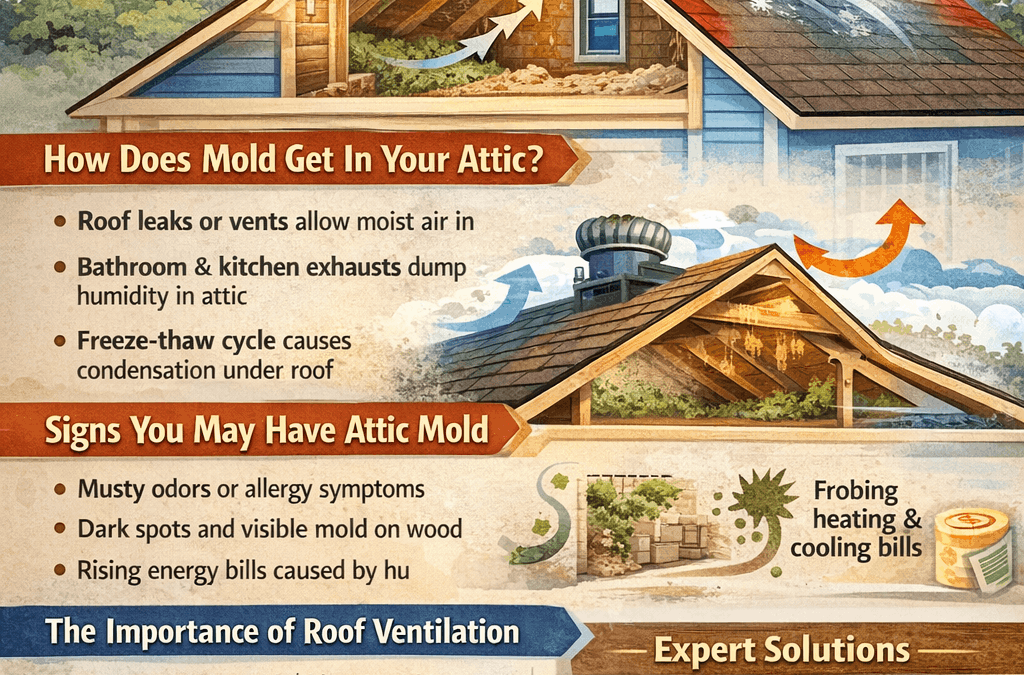
Attic mold is one of the most misunderstood problems homeowners face. Many people assume mold forms because of roof leaks alone, but in reality, poor ventilation is often the primary cause. Even homes with newer roofing systems can develop serious moisture issues when airflow inside the attic is restricted.
If you have noticed musty odors, dark spots on rafters, or unexplained humidity in upper rooms, you may already be dealing with mold in your attic. Understanding how roofing design and ventilation work together is essential for solving the issue permanently rather than treating symptoms temporarily.
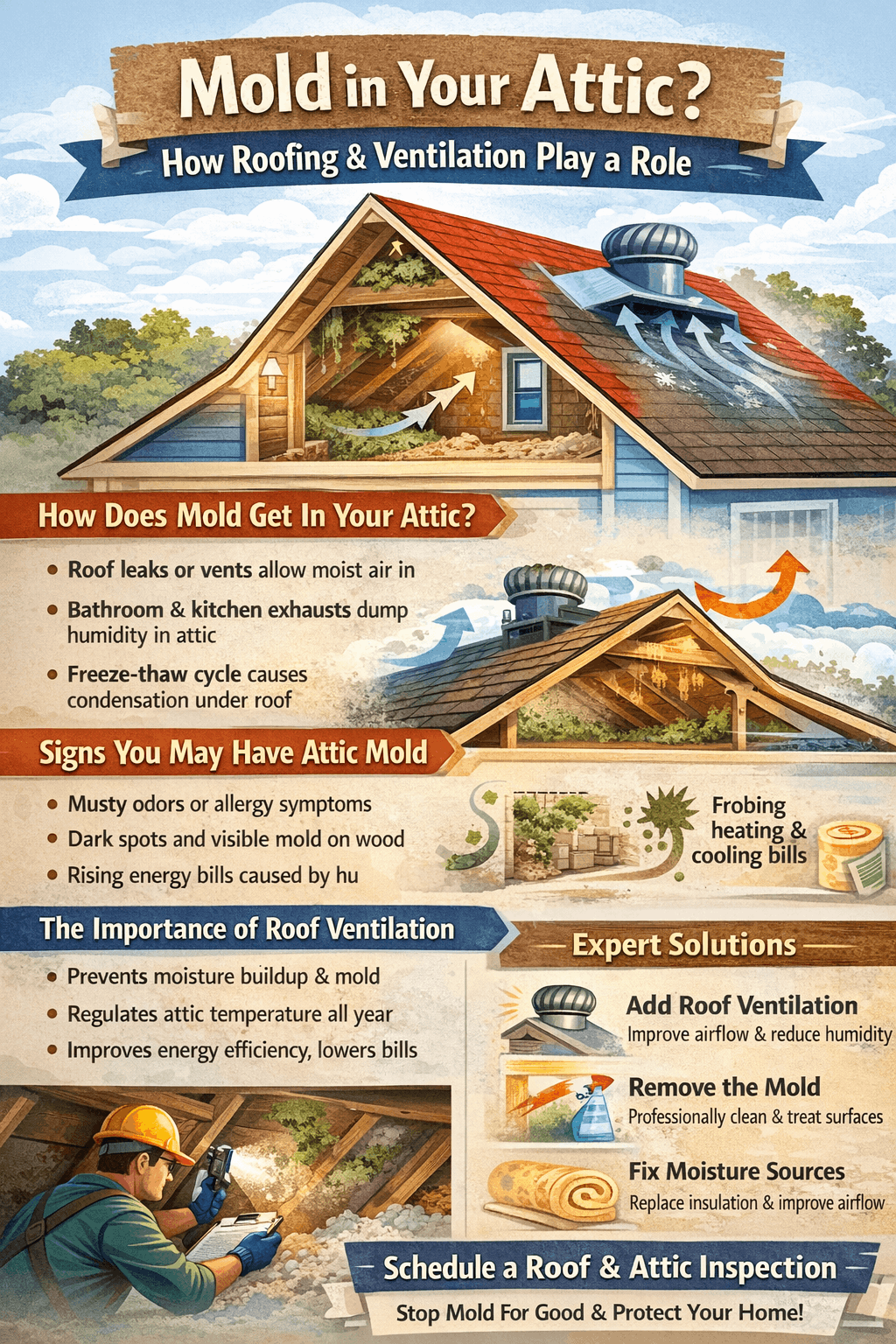
Why Attics Are Vulnerable to Mold Growth
An attic sits at the intersection of indoor living conditions and outdoor weather exposure. Warm air from inside the home naturally rises and enters the attic space. During colder months, this warm air meets cooler roof surfaces, creating condensation. That trapped moisture becomes the perfect environment for mold growth.
Without proper airflow, humidity remains suspended inside the attic. Over time, wooden structures absorb moisture, insulation loses effectiveness, and mold colonies begin spreading across decking and rafters. Many homeowners are surprised to learn that mold can develop even when there are no visible roof leaks. Ventilation imbalance—not roofing failure—is often the real issue.
Mold Health Risks: Why Attic Mold Matters
Attic mold isn’t just a structural concern—it poses genuine health risks for household occupants. Mold releases spores that travel through air movement, eventually reaching living spaces below. Even when mold is confined to the attic, its effects can spread throughout the home.
Common health effects from mold exposure include respiratory irritation, persistent coughing, nasal congestion, throat irritation, and eye discomfort. People with asthma or allergies often experience worsening symptoms. Prolonged exposure can trigger reactions even in individuals without pre-existing sensitivities.
Certain mold species produce mycotoxins—compounds that can cause more serious health effects with extended exposure. While not all attic mold is toxic, any significant mold growth should be taken seriously. Children, elderly household members, and those with compromised immune systems face elevated risks.
The connection between attic mold and indoor air quality is direct. As warm air rises through ceiling penetrations, light fixtures, and attic access points, it carries mold spores into living areas. Addressing attic mold protects both the structure and the people living beneath it.
How Does Mold Get in Your Attic?
Mold spores exist naturally in the air. They enter attic spaces through small openings, soffits, ventilation systems, or even through indoor air movement. Once moisture becomes available, spores activate and begin growing rapidly.
Several conditions typically contribute to attic mold formation. Bathroom and kitchen exhaust fans that release moist air into the attic instead of outside the home are one of the leading causes. Insufficient ventilation prevents moisture escape, while seasonal temperature changes create continuous condensation cycles.
Poor insulation also plays a role. Heat escaping from living areas warms the attic unevenly, increasing humidity buildup. In Michigan winters, this temperature differential accelerates condensation on cold roof sheathing.
The Bathroom and Kitchen Exhaust Mistake
One of the most common—and most preventable—causes of attic mold is improper exhaust fan venting. Bathroom fans and kitchen range hoods are designed to remove moisture-laden air from living spaces. When these systems terminate in the attic rather than outside the home, they deposit warm, humid air directly into the attic space.
A single bathroom exhaust fan can release several pints of water vapor daily. Over a heating season, that moisture accumulates on cold attic surfaces, saturating sheathing and framing. The problem is invisible until mold growth becomes extensive.
Proper exhaust venting routes ductwork through the attic and out through the roof or a gable wall. Ductwork should be insulated to prevent condensation inside the pipe. Flex duct should be kept as short and straight as possible—long runs with multiple bends reduce airflow and can allow moisture to pool.
If your home has exhaust fans venting into the attic, correcting this is one of the highest-impact improvements you can make for attic health.
Roof Ventilation Principles: Intake and Exhaust Balance
Effective attic ventilation relies on balanced airflow between intake and exhaust. Fresh air enters through intake vents positioned low on the roof—typically at the soffits or eaves. Warm, moist air exits through exhaust vents positioned high—at the ridge, near the peak, or through the roof surface.
This creates continuous air circulation: cool air enters low, warms as it absorbs moisture, rises naturally, and exits high. The cycle repeats constantly, preventing humidity from accumulating.
Balance is critical. If intake exceeds exhaust capacity, air pressure builds in the attic with nowhere to escape. If exhaust exceeds intake, the system pulls air from wherever it can—often through ceiling penetrations that draw conditioned air from living spaces. Either imbalance compromises performance.
The general guideline is 1 square foot of net free ventilation area for every 150 square feet of attic floor space, divided equally between intake and exhaust. Some building codes allow reduced ventilation when vapor barriers are present, but balanced airflow remains essential regardless of total area.
Ventilation Types: Understanding Your Options
Several ventilation components work together to create effective attic airflow. Each serves a specific function in the intake-exhaust system.
Soffit vents are positioned in the eave overhangs, providing intake airflow at the lowest point of the attic. They may be continuous strips running the length of the soffit or individual vents spaced at intervals. Soffit vents are essential for balanced systems—without adequate intake, exhaust vents cannot function properly.
Ridge vents run along the roof peak, providing exhaust at the highest point. They’re covered by cap shingles and are nearly invisible from the ground. Ridge vents work continuously without power, relying on natural convection and wind movement. When paired with adequate soffit intake, ridge vents provide excellent whole-attic ventilation.
Gable vents are louvered openings in the gable walls at each end of the attic. They can function as either intake or exhaust depending on wind direction and pressure. Gable vents work well in simple attic configurations but may create dead zones in complex roof structures where air doesn’t circulate to all areas.
Roof-mounted exhaust vents (box vents or turtle vents) are individual units installed on the roof surface. They provide exhaust ventilation and work best when distributed across the roof to prevent dead zones. Multiple smaller vents often perform better than a single large vent.
Powered attic ventilators actively pull air through the attic using electric fans. They’re effective for homes with persistent humidity problems or inadequate passive ventilation. Modern units include thermostats and humidistats that activate automatically when conditions warrant. However, powered vents consume energy and can create negative pressure that pulls conditioned air from living spaces if intake ventilation is inadequate.
Solar-powered ventilators offer a middle ground—active ventilation without ongoing electrical costs. They operate during daylight hours when attic heat buildup is typically highest.
Signs of Poor Attic Ventilation
Several indicators suggest attic ventilation is inadequate:
Visible moisture or frost on the underside of roof sheathing during cold weather indicates condensation is occurring faster than ventilation can remove it.
Dark staining on rafters, sheathing, or other wooden components suggests moisture exposure and possible mold growth.
Musty odors in upper floor rooms or near attic access points indicate elevated humidity or active mold.
Compressed, damp, or discolored insulation has absorbed moisture and lost effectiveness. This often appears first near the roof edge where temperature differentials are greatest.
Peeling paint or moisture stains on ceilings below the attic suggest condensation is reaching living spaces.
Ice dams forming at roof edges during winter—while influenced by multiple factors—often indicate heat escaping into the attic due to inadequate ventilation and insulation.
Unusually high cooling costs during summer may indicate trapped attic heat radiating into living spaces because ventilation isn’t removing it.
How Ventilation Failures Lead to Moisture Buildup
When ventilation systems fail or are inadequate, moisture has nowhere to go. The physics are straightforward: warm air holds more moisture than cold air. When warm, humid air contacts cold surfaces—like roof sheathing in winter—it releases moisture as condensation.
In a properly ventilated attic, this moisture is carried away before it can accumulate. In a poorly ventilated attic, condensation forms faster than it evaporates. The sheathing stays wet. Wood absorbs moisture. Conditions become ideal for mold.
Common ventilation failures include blocked soffit vents (often by insulation that has shifted or been installed incorrectly), insufficient vent area for the attic size, mixing of ventilation types that creates short-circuiting, and painted-over or debris-clogged vents.
Even homes with visible ventilation components can have inadequate actual airflow. A home may have ridge vents installed but soffits blocked by insulation, creating the appearance of ventilation without the function. This is why ventilation failures rank among the most common roof problems and often require professional assessment.
Insulation and Ventilation Interaction
Insulation and ventilation work together but can conflict if not properly coordinated. Insulation’s job is to prevent heat transfer between living spaces and the attic. Ventilation’s job is to remove moisture and regulate attic temperature.
Problems arise when insulation blocks ventilation pathways. Blown-in or batt insulation pushed against the roof edge can cover soffit vents, eliminating intake airflow. This is one of the most common ventilation failures in existing homes.
Proper installation includes baffles—channels that maintain an air gap between insulation and roof sheathing at the eaves. These baffles allow air to flow from soffit vents into the attic while insulation extends to the roof edge for thermal protection.
Inadequate insulation creates its own problems. Heat escaping from living spaces warms the attic unevenly, melting snow on the roof and creating condensation on cold surfaces. The solution isn’t choosing between insulation and ventilation—it’s ensuring both work together correctly.
Remediation: When to Call a Mold Specialist vs. a Roofer
Addressing attic mold requires understanding what caused it and who is best equipped to fix it. The answer often involves both mold remediation professionals and roofing contractors, but in a specific sequence.
Call a mold remediation specialist when mold growth is extensive (covering more than about 10 square feet), when occupants are experiencing health symptoms, or when mold has penetrated deeply into porous materials like sheathing or framing. Mold specialists have containment equipment, protective gear, and treatment methods appropriate for significant contamination. They can also test to identify mold species if health concerns warrant it.
Call a roofing professional when mold growth is limited and the primary need is identifying and correcting the moisture source. If a roof leak is contributing to moisture, that must be repaired regardless of who handles the mold. More commonly, the roofing professional’s role is assessing and improving ventilation—the correction that prevents mold from returning.
In many cases, the right sequence is: roofing assessment to identify the moisture source, ventilation improvements to prevent future buildup, and then mold remediation to address existing growth. Remediating mold without fixing ventilation guarantees the problem returns.
For minor surface mold on accessible areas, homeowners can sometimes handle cleaning themselves using appropriate safety precautions (N95 respirator, eye protection, gloves). However, any mold that has penetrated wood or covers substantial area should involve professionals.
Request an Evaluation
If you’ve noticed signs of moisture, musty odors, or visible mold in your attic, the first step is understanding what’s causing it. Request a free attic ventilation assessment to identify airflow problems and get a clear path toward correction.
Conclusion
Mold in the attic is rarely just a mold problem—it’s usually a ventilation problem that created conditions for mold to thrive. Understanding how intake and exhaust balance, how different vent types function, and how insulation interacts with airflow helps homeowners recognize warning signs early.
The health risks of attic mold are real. Respiratory irritation, worsening allergies, and long-term exposure effects make this more than a cosmetic concern. Proper ventilation prevents the moisture accumulation that allows mold to establish.
Whether the solution involves correcting exhaust fan routing, improving soffit intake, adding ridge ventilation, or professional mold remediation, addressing the root cause—ventilation—ensures the fix is permanent rather than temporary.
Frequently Asked Questions
Can attic mold spread to the rest of the house?
Yes. Mold spores travel through air movement, entering living spaces through ceiling penetrations, light fixtures, and attic access points. Even mold confined to the attic can affect indoor air quality throughout the home.
How do I know if my attic ventilation is adequate?
Signs of inadequate ventilation include moisture or frost on sheathing, musty odors, dark staining on wood, compressed or damp insulation, and ice dams in winter. A professional assessment can measure actual airflow against requirements.
Should bathroom exhaust fans vent into the attic?
No. Bathroom and kitchen exhaust fans should always vent outside the home, not into the attic. Venting into the attic deposits moisture-laden air directly where it causes the most damage.
Is attic mold dangerous to my health?
Attic mold can cause respiratory irritation, worsen allergies and asthma, and in some cases produce mycotoxins with more serious health effects. Children, elderly individuals, and those with compromised immune systems face elevated risks.
Do I need to replace my roof if I have attic mold?
Not necessarily. Most attic mold results from ventilation problems, not roofing failure. Correcting ventilation and remediating existing mold often resolves the issue without roof replacement. However, if sheathing has rotted significantly, affected sections may need replacement.